Thursday, January 8, 2026
Beauty by Roger Scruton
Friday, July 11, 2025
"Adventures Among Books" by Andrew Lang
Lang calls this essay his literary biography saying that he has a much easier time remembering books than he does people. He writes, Some are soldiers from the cradle, some merchants, some orators; nothing but the love of books was the gift given to me by the fairies.
From an early age he was surrounded by books and those who loved to read them. He remembers “reading” Midsummer Night’s Dream as a small boy in a candlelit room where someone was playing the piano; he was sitting by the fire looking at an edition with pictures of fairies in it. The fairies seemed to come out of Shakespeare’s dream into the music and the firelight… It seemed an enchanted glimpse of Paradise.
At age four he began to teach himself to read by picking out the words and letters of a poem he had heard so often that he had it memorized: Elegy on the Death andBurial of Cock Robin. At age nine, he read his first novel, which was Jane Eyre. This was a creepy tale for a boy of nine, and Rochester was a mystery, St. John a bore. But the lonely girl in her despair, when something came into her room, and her days of starvation at school, and the terrible first Mrs. Rochester, were never to be forgotten.
He tells how he hated Greek until he discovered Homer. The very sound of the hexameter, that long, inimitable roll of the most various music, was enough to win the heart, even if the words were not understood. But the words proved unexpectedly easy to understand, full as they are of all nobility, all tenderness, all courage, courtesy, and romance…. After once being initiated into the mysteries of Greece by Homer, the work of Greek was no longer tedious.
He
summarizes his love of all things Greek by writing, We cannot find any wisdom
more wise than that which bids us do what men may and bear what men must. Such
are the lessons of the Greeks, of the people who tried all things, in the
morning of the world, and who still speak to us of what they tried in words
which are the sum of human gaiety and gloom, of grief and triumph, hope and
despair. The world, since their day, has but followed in the same round, which
only seems new: has only made the same experiments and failed with the same
failure, but less gallantly and less gloriously.
“AdventuresAmong Books” was written in 1872 when Lang was still a young man. Near the end
of the essay, he writes about how he became interested in folklore and
anthropology. Little did he know that his most memorable life’s work would grow
out of that interest. The first “Fairy Book” was published in 1889.
Blessings,
Friday, June 13, 2025
The Literary Lives of the Inklings by Philip and Carol Zaleski
Philip and Carol Zaleski have given us a great gift with their painstaking research on each of the major inklings (J.R.R. Tolkien, C.S. Lewis, Charles Williams and Owen Barfield) and how their lives and writings intertwined. The name “Inklings”, according to Tolkien, was little more than a “pleasantly ingenious pun suggesting people with vague or half-formed intimations and ideas, plus those who dabble in ink.” But History would record that, however modest their pretensions, their inkblots were no mere dabblings.
The group came together at a strategic time. WWI had left many in despair, but in others it had instilled a longing to reclaim the goodness, beauty, and cultural continuity that had been so violently disrupted. The Inklings came together because they shared that longing; they believed, as did their literary and spiritual ancestors, that ours is a fallen world yet not a forsaken one, which was a belief that set them at odds with many of their contemporaries. Lewis described the Inklings to Williams as “a group of Christians who like to write.” The Zaleskis add that they shared more common characteristics than that including intellectual vivacity, love of myth, conservative politics, memories of war, and a passion for beef, beer, and verbal battle.
The book highlights the idiosyncrasies of each member of the group beginning with Tolkien’s rapid, slurring, unintelligible lectures, which students endured because, as one student remarked, “Tolkien could turn a lecture into a mead hall in which he was the bard and we were the feasting, listening guest. Speaking in Anglo-Saxon turned Tolkien’s leaden tongue to gold.” I was particularly interested in the details of Charles Williams' life because of C.S. Lewis' glowing accounts of him in his letters. The Zaleski's paint quite a different picture of him as a very strange man!
They also describe
the periodic friction between the members, particularly Tolkien’s impatience with
Williams because he disliked William’s fiction, but also because he distrusted
Williams’ fascination with the occult. Lewis and Barfield disagreed often (and
strongly) on the principles of anthroposophy. At times Tolkien and Lewis clashed
in their literary views, but their friendship endured through the decades. When
Lewis died, Tolkien wrote, “So far I have felt the normal feelings of a man of
my age – like an old tree that is losing all its leaves one by one, but this
feels like an axe-blow near the roots.”
Of course,
in 500 pages, you are bound to find lots more information (trivia?) than in other
books. It was fun to read that some of the early reviews of The Lord of the
Rings called it “juvenile trash” and “an overgrown fairy story” (!)
According
to the Zaleskis, By the time the last inkling passed away on the eve of the 21st
century, the group had altered, in large or small measure, the course of
imaginative literature, Christian theology and philosophy, comparative
mythology, and the scholarly study of the Beowulf author, of Dante, Spenser,
Milton, courtly love, fairy tale, and epic; and drawing as much from their
scholarship as from their experiences of a catastrophic century, they had
fashioned a new narrative of hope amid the ruins of war, industrialization, cultural
disintegration, skepticism, and anomie.
For three months this was my bed-time book, and it brought me many hours of pleasure.
Blessings,
Friday, April 18, 2025
Why Poetry by Matthew Zapruder
When I saw Zapruder’s book on Kindle Unlimited, I was eager to see what he had to contribute to the discussion. I was delighted with his opening sally that Poetry isn’t in any danger, and never has been. And I’m quite sure there will be poetry as long as there are people who can speak, and probably even after. [And this delightful jab:] Probably even robots will write it, just as soon as they get souls.
The central
question of the book is how poetry creates a heightened sense of awareness (what
Zapruder calls “a poetic state of mind.”) It happens through the form of the
poem, which guides the mind of a reader. It happens through leaps of
association. And it happens as the poem explores and activates and plays with
the nature of language itself.
He contends
that there is no such thing as poetic language. The words used in poetry are
every day words, but their energy comes primarily from the reanimation and
reactivation of the language we recognize and know. In poetry, we see how
language can be made deliberately strange, how it becomes “difficult” in order
to jar us awake. One of the ways that poetry reanimates language is in its
use of unexpected associations or metaphors. (Like when Emily Dickinson calls a
snake a “whip-lash” or when Richard Crashaw writes that “Graves are beds now
for the weary.”)
He also
insists that poetry is not a secret code, and that it is not written to be
deliberately elusive or obscure. (I would agree up to a point since I find most modern
poetry to be purposefully vague. Ironically, the second half of the book is filled
with examples of modern poems, which Zapruder painstakingly explains because otherwise they make no sense.)
In general,
says, Zapruder, poetry requires no special knowledge, only attention. The
meaning of the poem resides on the page, and is available to an attentive
reader. Paying attention is essential and this close reading of the text is
essential not only for literary enjoyment, but he would add, it’s necessary for
survival in this modern world. The more we are colonized by our devices and
the “information” and “experiences” that they supposedly deliver, the more we
need a true experience of unmonetized attention.
The first half of the book was helpful and insightful; he detours off a few times to decry the evils of climate change, terrorism, inequality, environmental issues, etc. which didn’t seem to have anything to do with the topic. And, as I wrote above, the second half had many examples of difficult poetry that, instead of encouraging people to read it, would scare them off permanently. Still, I enjoyed gaining insights into how poetry makes its impact, and look forward to continuing my journey toward understanding it better.
Thursday, April 3, 2025
Pages from a WII Chaplain's Diary by Clarence E. Walstad
At 40 years of age, successful Lutheran pastor,
Clarence Walstad, enlisted in the army as a chaplain, leaving behind his wife
and their three young children. These are the touching letters he writes to Ruth
describing his 2 ½ years of army life.
The overriding theme of the letters is his desire for the men in his outfit to come to saving faith in Christ. As his ship nears North Africa, he writes: (4/14/43) The morale of the men is good. Wonderful facilities are provided to keep them occupied. They have access at all times to shelves of books, magazines, parlor games, several pianos, victrolas, etc. But ultimately, morale must depend, not on escape mechanisms, but upon the ‘soul that is fixed on God’ by faith.
One of his early assignments was to work in a hospital unit in Morocco connected to a German and Italian POW camp. In July of 1943, he tells a poignant story of playing his autoharp in his office and having the men in the hospital tents begin to sing along with him. Many of these POWs understand a little English, he wrote. All could follow the music. Because many of the Lutheran hymns he knew had been translated from the German, some prisoners joined in the singing in their own language. We harmonized on “Fairest Lord Jesus”, “Oh, Sacred Head now Wounded”, “When I Survey”, and then ended up by singing “Silent Night” in five languages. Several of them broke down as the familiar strains floated out on the night air. Afterward I spoke to them a little to say that though we are enemies there are some things we all have in common: home, mother, God and the love of Jesus, who came to earth that Christmas Eve. Poor lads, they too believe in the cause for which they have been suffering in this malaria infested hole, for almost two years.
Later he is attached to army units in France and
Germany where the men are fighting and he has little opportunity for church
services. I was complaining to my boys today that there just isn’t an awful
lot a chaplain can do here these days as it is suicide to gather men in groups.
But one of the fellows spoke up and said, “Chaplain, just seeing you around
when the shells are flying, is a help.” One of the soldiers attached to that
unit spoke of it as “an awesome sight to see that big man (6’4”) crawling from
foxhole to foxhole with a message of comfort and encouragement from the Lord to
frightened and anxious soldiers during the heat of battle.”
Walstad’s devotion to his calling, his unstinting acts
of service, and his cheerful acceptance of hardships made for heartwarming
letters that bolstered my faith. Without
a doubt, this will be one of my favorite books of the year.
Thursday, February 6, 2025
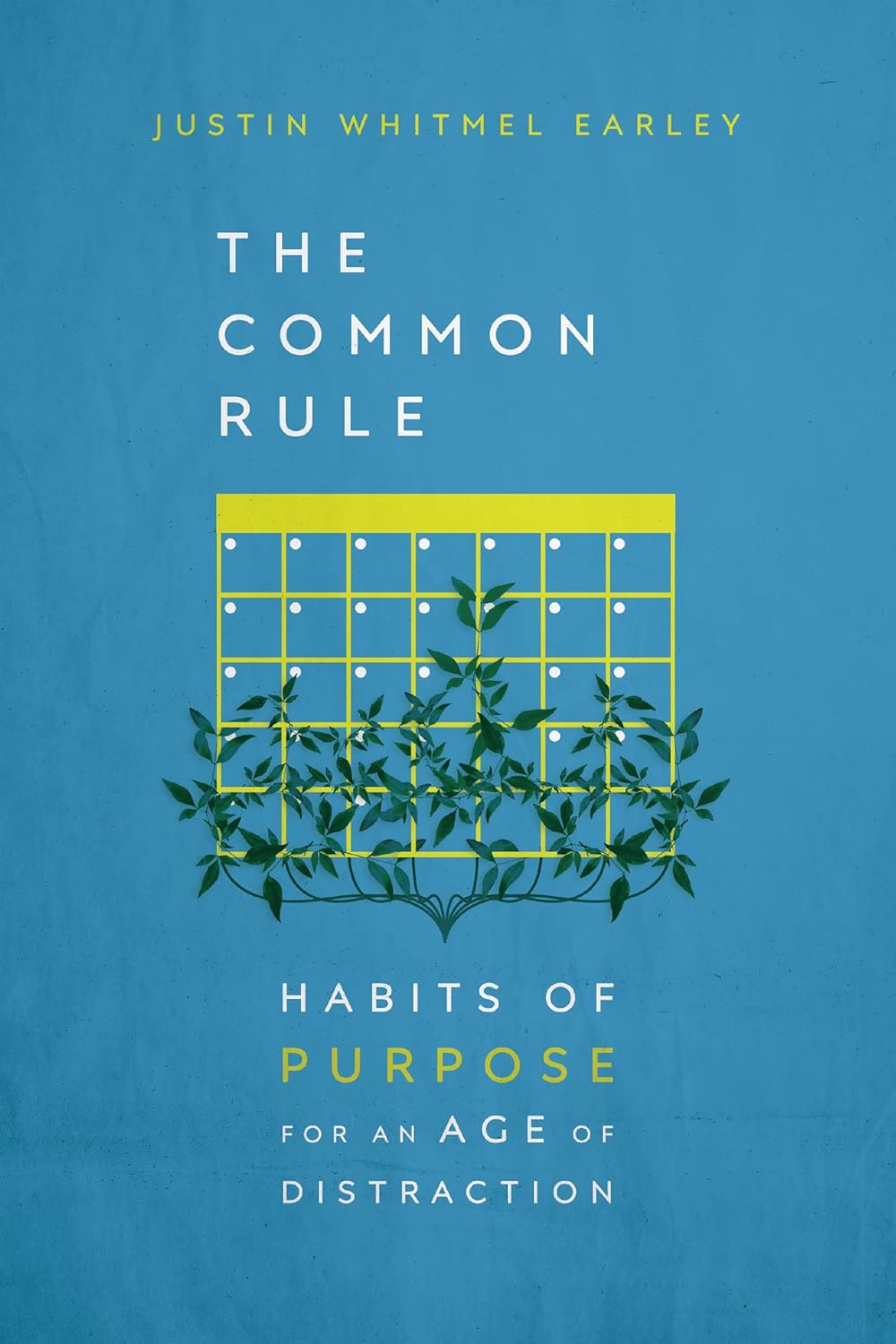
The Common Rule by Justin Whitmel Earley
Justin
Whitmel Earley encourages four daily habits and four weekly habits that are
designed to draw us closer to God and wean us away from dependence on social
media for affirmation and dopamine hits. The daily habits are 1) Kneel for
prayer three times a day, 2) Eat one meal with others, 3) Spend one hour with your
cellphone off, 4) Read Scripture before turning on your phone.
The weekly
habits are 1) Spend one hour of conversation with a friend, 2) Curate your
media (movies/videos) to four hours, 3) Fast from something for 24 hours, and
4) Keep the Sabbath.
The chapter
on Daily Habit #3 (Turn of your phone for one hour a day) was the most
important chapter in the book for me, not because I don’t already limit my cell
phone use, but because it gave good theological reasons for continuing to do
so. Presence is the essence of life itself. It’s at the heart of who we are
because presence is at the core of our relationship with God. From creation to
salvation, the story of the Bible is fundamentally a story of presence. Eden
was Eden because the unmediated presence of God was there. God was with Adam
and Eve till sin broke the bliss of that presence. After they sinned, Adam and
Eve wanted to cover their nakedness and hide. This is the hallmark of life as
we know it now. We hide from each other
and we hide from God. We long for the face of God, but we can’t bear his gaze
either. Sin has turned a people meant for presence into a people of absence.
Fortunately, the story of the Bible doesn’t end there. God in His mercy still
pursues His rebellious children.
Although I
appreciated this book very much, I found parts of it to be annoying (Earley’s
bragging about how good he is at speaking Chinese was one example). Also, the
subtitle of this book could have been “Spiritual Disciplines for Social Justice
Warriors” because of how often he tacked on social justice issues to each
discipline. Don’t get me wrong. I LOVED his emphasis on spiritual disciplines
that are rooted in the two commandments to “Love God and love your neighbor.” What
better motivation can you have for getting off your phone than to be fully present
to those around you and to pursue the goals that God has put into your heart to
fulfill His purposes?
But some of the ways he prescribes to do that are just plain odd. In the chapter on curating your media time, he strongly suggests that you watch things that show the injustice in the world so that you can feel miserable about it. But feeling bad about injustice is not biblical justice. (See Voddie Baucham's explanation of the difference in this video.)
Anyway, this book stretched me in a lot of ways and I'm glad I read it. Any thoughts?
Thursday, October 24, 2024
The Four Loves by C.S Lewis
The four
loves are 1) Storgé/familial love, 2) Friendship, 3) Eros/romantic
love, and 4) Agape/Charity. His description of storgé was so endearing that I
had to stop listening and write it down. It comes from Greek and refers to
affection, especially of parents to children.
It’s
usually the humblest of the loves. It gives itself no airs. Storge is modest,
even furtive and shame-faced. Storge has a very homely face. So have many of
those for whom we feel it. It’s no proof of your cleverness or perceptiveness
or refinement that you love them nor that they love you. To have to produce
storge in public is like getting your household furniture out for a move. It
was all right in its native place, but it looks tawdry out of doors. And the
feeling of storge is so nearly organic, so gradual, so unemphatic, that you can
no more pride yourself on it than on getting sleepy towards bedtime. It lives
with humble, unpraised private things: the thump of a drowsy dog’s tail on the
kitchen floor, the sound of a sewing machine, easy laughter and easy tears on
some shrewd and wrinkled old face, a toy left on the lawn. It’s the most
comfortable and least ecstatic of loves. It is to our emotions what soft
slippers and an easy, almost worn-out chair, and old clothes are to our bodies.
It wraps you round like a blanket almost like sleep. At its best, it gives you
the pleasure, ease, and relaxation of solitude without solitude itself.
Beautiful,
right? But just when I was completely enamored, he delineates all the ways this
kind of love can be distorted. That is
how the book goes. He explains each type of love at its glorious best and then
shows how easily it can turn into something manipulative and selfish. His conclusion
comes in the final chapter where he emphasizes the importance of self-giving love as
the only solution for keeping the other loves from becoming corrupted. In this chapter he
writes his famous lines:
To love at
all is to be vulnerable. Love anything, and your heart will certainly be wrung
and possibly be broken. If you want to make sure of keeping it intact, you must
give your heart to no one, not even to an animal. Wrap it carefully round with
hobbies and little luxuries; avoid all entanglements; lock it up safe in the
casket or coffin of your selfishness. But in that casket – safe, dark,
motionless, airless – it will change. It will not be broken; it will become unbreakable,
impenetrable, irredeemable…. The only place outside Heaven where you can be
perfectly safe from the dangers and perturbations of love is Hell. (p. 121)
Note: The
book gets a bad rap for some comments he makes about the differences between
men and women, but, honestly, don’t let that keep you from reading it. Anything
written by Lewis is worth tackling for his wonderful clarity and depth.
Friday, July 19, 2024
Stories of Faith and Courage from World War II by Larkin Spivey
I must confess that most of my reading about WWII (over 100 books) is about the home front or POW stories. I know very little about specific strategic battles. When I picked up Stories of Faith and Courage from WWII, I was expecting the personal narratives that I’m accustomed to (i.e., uplifting stories of people whose faith helped them to get through the trials of the war), but it was something quite different.
Each month covers a different battle or aspect of
the war. January covers the European front with a brief historical overview and includes a map which shows where the major battles were fought. The daily
readings, though not heavy on military details, mention the battles, and it is
very helpful to have the map at hand. Though the readings are mostly personal
reflections from diaries, letters and speeches, I appreciated being able to
read them in the context of the much bigger picture.
Also, though many of the entries were uplifting and encouraging, many
others gave details of the thousands and thousands of lives lost. Intermixed
with letters displaying unusual courage were letters admitting discouragement
and despair. Accounts of heroism were inspiring yet heartbreaking. It was a very sobering read.
Here is
just one example from March 13:
Life aboard
a merchant ship in convoy across the Atlantic was a mixture of boredom and
fear. Long days and nights passed without incident. However, when something
happened, it usually happened suddenly. Life jackets and precious valuables
were kept close at hand. There was also the issue of where to sleep.
The civilian
Merchant Marines who manned the ships grimly calculated where they slept aboard
ship by the cargo they carried. If you were hauling a load of iron ore, you
slept on deck for you had only a few seconds to clear the ship once a torpedo
hit. If you carried general cargo, you could sleep below decks but kept your clothes
on because your survival time was calculated in minutes. If, however, your ship
carried a load of aviation fuel, you were free to sleep naked below decks, with
the door closed since you would never have the time to escape the certain and
sudden oblivion of a torpedo attack.
This is supposed to be read as a daily devotional book, but I
had trouble putting it down. It would be an excellent primer for someone
who wants a good overview of the history of the war. I am so glad I read it.
Friday, June 7, 2024
The Dazzling Darkness by Guy Bowden
Bowden opens
the book self-deprecatingly: Books about golf are usually written by experts;
so are books about Prayer. This one is not. It is written by one who has made,
by personal experience, most of the mistakes it is possible to make in praying,
and has discovered by the method of trial and error a great deal about “How Not
to Pray.” His advice is extremely practical and his excellent prose is sprinkled
with quotes from a variety of writers such as St. Teresa of Avila, St. Francis
de Sales, Anthony Trollope, C.S. Lewis, E.M. Forster, Shakespeare, Dante, biblical
authors, and Carl Jung (more about that later).
Although
Bowden does not deny the mystical aspects of prayer, he affirms again and again
that it is often just plain hard work. Yet it is a "duty" that
brings rich spiritual dividends. I loved his constant emphasis on prayer as
willful obedience – not as a slave to a master, but as a son to a beloved
father. If we wait until we “feel like” praying, it will rarely happen.
To realize
His presence is a very different thing from having sentimental fancies of sugary
religiosity in which we can imagine ourselves to be enveloped as it were in the
eiderdown of His protective care. To seek for an emotional thrill in every
prayer is sentimental nonsense. If the emotion comes, it comes; let us thank
God for the refreshment, take courage and go forward. If it does not come, it
does not; we have to accept the fact.
We must not
think, then, that because there may be very little pleasure in prayer, we must,
therefore, be failing miserably. To judge the worth or the value of prayer by
the amount of pleasure it affords is to apply far too subjective a test. It
directs attention to us and our feelings rather than to God and His purpose and
thereby makes us the center of interest instead of Him. If we expect prayer to
be always pleasant, we are saying in effect, “Every time I say my prayers I
ought to be provided with appropriate feelings” – presumably by God. But the assumption
that God ought to do anything wrecks the whole relationship between soul
and God, because it puts God in the position of a servant who is expected to
perform certain duties, whereas He is King and sitteth between the cherubim.
(p. 24)
My only
quibble with the book is Bowden’s occasional nod to psychology. He never lets
it take precedence over true faith, but he interjects a Jungian understanding
of the soul when he talks about repression and the subconscious in chapter 10.
That did not, however, dampen my enthusiasm for the book. It was a great
encouragement to me to be more diligent in this area of my Christian life
knowing that God is greater than all my weaknesses. And that the rewards far
surpass any effort involved.
Thursday, November 30, 2023
What I Read and Watched in November
Friday, September 15, 2023
The Supper of the Lamb by Robert Farrar Capon
He continues: The world looks as if it has been left in the custody of a pack of trolls. Indeed, the whole distinction between art and trash, between food and garbage, depends on the presence or absence of the loving eye.
Hence his emphasis on the importance of slowing down and paying attention to life’s myriad details, including the delights of cooking from scratch. At times he uses a wise grandfatherly tone; at other times he is more like a back-slapping older brother who loves a good joke and a good cigar. Some passages were hilariously funny. He waxes eloquent on the beauty of onions, the necessity of sharp knives and (most memorable of all) the glory that is baking soda.
Capon uses
cooking as a metaphor for life. Don’t go for the processed pre-cooked garbage
that passes as food because it’s more convenient. The best things in life take
time and care, and may even give you heartburn. “Real life” will cost you.
We were
given appetites not to consume the world and forget it, but to taste its
goodness and hunger to make it great. That is the inconsolable heartburn, the
lifelong disquietude of having been made in the image of God. All man’s love is
vast and inconvenient. It is tempting, of course, to blunt its edge by caution.
It is so much easier not to get involved – to thirst for nothing and no one, to
deny that matter matters and, if you have the stomach for it, to make your bed
with meanings which cannot break your heart. But that, it seems to me, is
neither human nor Divine. If we are to put up with all other inconveniences out
of love, then no doubt we must put up with the bother of love itself and not
just cut and run for cover when it comes.
The last 25%
of book is recipes, which are a pleasant, but non-essential addition. The main "recipe" is in the first 250 pages and it is on how to live life to the fullest.
May your eyes be open “to see the bounty of small things.”
Thursday, April 20, 2023
12 Ways Your Phone is Changing You by Tony Reinke
Friday, October 28, 2022
The Valley of Vision by Arthur Bennett
Thursday, September 22, 2022
A Serious Call to a Devout and Holy Life by William Law
After 30 years of teaching Theology of John Wesley, I finally decided to read A Serious Call because apart from the Bible it was one of the books that most formed Wesley’s thinking about Christianity. Law begins this devotional classic by defining the nature and extent of Christian devotion, which holds little resemblance to what passes for Christianity today. He reminds us that it is a “serious call” after all, and requires every ounce of our being.
The first chapter goes straight to the sticky issue of how Christians should spend their money. Using our money in any way we please, says Law, shows we lack intention to please God in all our actions. (Wesley followed Law’s advice to the letter by living frugally all of his life and giving money away as fast as possible. He felt that accumulating wealth was equivalent to holding on to hot coals.)
The next chapters encourage a wholehearted pursuit of God by rising early, reading the Scriptures and singing the Psalms. He writes: Prayer is the nearest approach to God, and the highest enjoyment of Him that we are capable of in this life. It is the noblest exercise of the soul, the most exalted use of our best faculties and the highest imitation of the blessed inhabitants of heaven.
Starting with Chapter 16 he adds suggestions for how to take advantage
of certain hours of the day for specific prayers. At 9 a.m., for example, a
Christian should spend a few minutes focusing on his need for humility. (He follows with a whole chapter on what true humility entails.) In Chapter 20
he recommends using the noon hour to pray for more love toward others, and
follows this up with a clear explanation of the high cost of real love. (This was my favorite chapter in the whole book and I felt it could easily have
been re-titled: "How to pray for those whom you despise and learn to love
them in the process.")
Chapter 22 advocates stopping at 3 p.m. to pray prayers of consecration and resignation to God’s will. The whole nature of virtue consists in conforming to, and the whole nature of vice in declining from, the will of God…. Whenever you find yourself disposed to uneasiness or murmuring at anything that is the effect of God’s providence over you, you must look upon yourself as denying either the wisdom or goodness of God. For every complaint necessarily supposes ill usage. (Ouch!)
In Chapter 23 he suggests stopping at 6 p.m. to review the day and confess any sins that were committed. Oddly, the updated version of this book removes all mentions of specific times of day (to avoid sounding too Catholic?) and thus robs the reader of a simple method for remembering when and how to pray for these needs. Tripp’s version was also jarringly anachronistic. The language was not updated very much, but the examples were, which resulted in old-fashioned English phrases next to illustrations about people playing video games, wearing yoga pants and watching movies. Halfway through the Tripp version, I switched to the original version and had no problem with the language or the original examples. And the Dover version came with very helpful footnotes.
Once I got hold of a good version (free download from my library), I couldn’t believe how much I loved
this book. It is a book to be read slowly and prayerfully that will comfort and
strengthen the heart of any earnest seeker.
Blessings,
Friday, September 9, 2022
You Are Not Your Own by Alan Noble
Weeks after finishing You are Not Your Own, its ideas continue to resonate with me. Noble sets out to explain how we Americans have come to the place where hyper individualism is killing us rather than fulfilling us.
He writes, If
I am my own and belong to myself, then I must define who I am…. And the
terrifying thing is that everyone else in society is doing the exact same
thing. Everyone is on their own private journey of self-discovery and
self-expression, so that at times, modern life feels like billions of people in
the same room shouting their own name so that everyone else knows they exist
and who they are – which is a fairly accurate description of social media.
The irony of
a culture that promises that you “can be all you can be” without reference to
any higher good or higher power is that no plateau is high enough. There’s
always some level of perfection or self-actualization just out of reach. The
freedom of sovereign individualism comes at a great price. Once I am liberated
from all social, moral, natural, and religious values, I become responsible for
the meaning of my own life. Hence the lie: If I am completely responsible for
my life, then the greatest moral failure would be for me to fail to pursue what
I desire most. I owe it to myself to be happy. The only problem with this is
that unlimited desire and consumption always leave us exhausted and empty.
But there
is good news, says Noble. Christ frees us from the unbearable burden of
self-belonging.
An
anthropology defined by our belonging to God is diametrically opposed to the
contemporary belief that we are autonomous, free, atomistic individuals who
find our greatest fulfillment in breaking free from all external norms. Our
selves belong to God, and we are joyfully limited and restrained by the
obligations, virtues, and love that naturally come from this belonging. This
living before God is not easy. It requires sacrifice and humility, perpetual
repentance and dependence upon Christ. In a secular age such as our own, it
requires an intentional effort to remember that we belong to Christ, and that
belonging is not merely a doctrine, but a reality that touches every aspect of
our lives.
This is a
tremendous book if you are feeling overwhelmed by breath-takingly rapid changes
in our society and want to step back and see how it all happened. It is also a
wonderful reminder to vigilantly resist the false promises the world offers for
self-fulfillment.
Interestingly, I was primed for this book by, first, experiencing ministry burnout and, second, by reading A Gentleman in Moscow. Both experiences caused me to question the frenzy of always doing more, and to ponder ways to live more humanly within our God-given limits.
Friday, January 28, 2022
The Collected Letters of C.S. Lewis, Volume 2
I’m finally reviewing my favorite book of 2021. Volume One of the Letters of C.S. Lewis covers his early life and ends with his conversion. In Volume Two (1931-1949), we see how he grows in his faith and begins writing his fiction and his apologetical books. I was drawn in from the very first letter and was kept interested by the variety of his correspondents and his overwhelming kindness and humility. I was taken aback initially by a bawdy joke he included in a letter to his brother, but chortled at his nickname for a project in which he was unwillingly involved (The Oxford History of English Literature) that he referred to as “O Hell!”
There is much
to savor in this volume: details of his friendship with Tolkien, his unbelievable patience
with Jane (a cantankerous woman who was Lewis’ houseguest until the end of
her life), his gentle, wise responses to people who asked him questions about
his faith, and the endless list of books he was reading.
In spite of
his brilliance as a thinker and writer, his letters are infused with a guilelessness
that is disarming. He wrote to a Catholic nun on August 9, 1939, Though
I’m forty years old as a man, I’m only about twelve as a Christian, so it would
be a maternal act if you found time to sometimes mention me in your prayers.
In another letter
written in April of 1935, he is renewing an old acquaintance and sums up his
life simply, My father is dead and my brother has retired from the army and
now lives with us…. I am going bald. I am a Christian. Professionally I am
chiefly a medievalist.
Friday, January 14, 2022
Anthony Trollope: An Autobiography
The doctor’s
vials and the ink-bottle held equal places in my mother’s rooms. I have written
many novels under many circumstances, but I doubt much whether I could write
one when my whole heart was by the bedside of a dying son. Her power of
dividing herself into two parts, and keeping her intellect by itself clear from
the troubles of the world, and fit for the duty it had to do, I never saw equaled.
I do not think that the writing of novel is the most difficult task which a man
may be called upon to do, but it is a task that may be supposed to demand a
spirit fairly at ease…. My mother went through it unscathed in strength, though
she performed all the work of day-nurse and night-nurse to a sick household –
for there were soon three of them dying.
Soon he was summoned to work as a clerk in the London Post office. He gives detailed descriptions of his post office duties through the years and how he managed to begin his own career as a novelist; he recalls his different books and how long they took to write and how much he got paid for them. Sometimes he compares how he felt about them with what the public felt about them. (He didn’t give a hang about public opinion.) Regarding TheSmall House at Allington, he wrote, In it appeared Lily Dale, one of the characters which readers of my novels have liked the best. In the love with which she has been greeted I have hardly joined with much enthusiasm, feeling that she is somewhat of a prig.
Chapter
Thirteen was a commentary on fellow Victorian novelists and includes Trollope’s
fascinating predictions of who would last and who would fade away. His “keepers”
are Thackeray and George Eliot. He acknowledges Dicken’s popularity, but vehemently
disagrees with it. His predictions for the “losers” were mostly right. He
predicted that the novels of Charles Read, Henry Bulwer, Annie Thackeray, Rhoda
Broughton, Charles Lever and Charlotte Brontë (!) would sink into oblivion.
Although
parts of this book were tedious, I was sad when it was over. The
narrator, Bernard Mayes (with his grandfatherly British voice), did such a good
job that I felt like I had just had a long conversation with a good friend that
suddenly came to an end.
I will close
with a favorite quote from Clifton Fadiman: Above all give me Trollope, from
whom I have received so much pleasure that I would willingly call him another
St. Anthony; his half a hundred novels are good for five years of bedside
reading. Of those who minister to the tired, night-welcoming mind, Trollope is
king. He never fails to interest, but not too much; to soothe, but not too
much. Trollope is the perfect novelist for the bedside.