Showing posts with label Children's Lit. Show all posts

Thursday, December 4, 2025

Reminscing about Books #7

This will be my last nostalgic post this year because my teaching schedule is lightening up, and soon I'll have the head space for reading and reviewing. I've missed writing about books!

In the year 2014, I wrote my one and only post that went viral (in a modest sort of way). I had discovered Librivox a few years earlier and was able to recommend some of the better readers. That garnered enough interest to get almost 8,000 views (rather than my average of about 50). One responder told me about Adrian Praetzellis who is absolutely remarkable as a narrator, especially for Treasure Island.

Two children's classics bowled me over that year: Charlotte's Web (reviewed here) and C.S. Evans' beautiful version of Sleeping Beauty (reviewed here and here). 

My final gem was David Copperfield by Charles Dickens (reviewed here). I'd been trying to like Dickens for decades, and this book turned me into a devoted fan. 

That was also the year I wrote my personal favorite post on Christian romance novels. I got a lot of suggestions for "better" Christian fiction, but am still not convinced. I devoured Grace Livingston Hill books as a teen, and read other Christian authors until I was about thirty. But when I began to read the classics (especially Trollope), I somehow lost my taste for the fluffier stuff. (I still like an occasional light, fun book, as you know if you've read this blog for any amount of time.)   

Have you found that your reading tastes have changed over the years? 

P.S. Amazon usually has an end-of-the year deal on Kindle Unlimited for 99 cents for three months. I saw it earlier, but couldn't find the link to post here. It would be worth it just to read the first ten Ngaio Marsh novels. But there are also quite a few D.E. Stevenson and Miss Read titles (cozy British village settings).

Blessings,
Friday, November 21, 2025

Reminiscing about Books #6

My last post was on the literary riches of 2011, but the next year was no different. In truth, because I read a book per week (sometimes two), 80 percent of them aren't worth blogging about. BUT the "cream" that floats to the top makes it all worthwhile. 

In 2012 I read a mix of theology, biography, detective fiction, and classic children's literture. I read my first Betsy-Tacy book, and was enchanted. (Review here.) Andrew Murray's book on The Two Covenants was profound, and gave me a deeper appreciation for the Old Testament (and for how all of it pointed to the future reality of the Cross.) I reviewed it here.

I rarely read modern titles, but Unbroken by Lauren Hildebrand was so highly tauted that I caved in. I could hardly put it down! (Review here.) Another WWII favorite that year was Helmet for my Pillow (reviewed here). 

I love books, but am very careful to wait for good deals so that I can stay within my budget. Anyway, when I heard about The Truest Fairy Talebased on the writings of G.K. Chesterton, I went against all my financial principles and sent away for a copy. It was worth it! (Reviewed here.) 

The last two highlights were Elizabeth Goudge's The Dean's Watch (reviewed here), and the Lord Peter/Harriet Vane mysteries by Dorothy Sayers. (I reviewed the first book, Strong Poisonhere.) What a glorious year!

Blessings,

Friday, October 24, 2025

Reminiscing about Books #4

2010 was a good year for accumulating new favorites. It was the first year I read D.E. Stevenson. Winter and Rough Weather is the third in a trilogy, but stood up on its own. I've read almost 40 of her novels since then and very few have disappointed. I even own 20 of her audiobooks! She is light without being fluffy, which gives me a good break from heavier reading.

I'd read some C.S. Lewis by this time, but when a friend loaned me Experiment in Criticism. I was so enamored that I shamelessly underlined fifty percent of it. (Of course, I bought her a replacement copy.) I wrote a review here.

Also that year, I read Peter Pan, and was absolutely charmed. (Reviewed here)

Two Catholic novels stretched me in good ways: Canticle for Liebowitz by Walter M. Miller and Silence by Shusako Endo. In my review of Silence, I explain how I've learned to appreciate the gravitas that Catholic authors bring to their fiction. Canticle for Liebowitz (reviewed here) turned me into a die-hard dystopian novel fan.

Another delighful discovery was Wednesday Wars, YA fiction by Gary Schmidt (a living author, for a change), which I reviewed here

Any thoughts on these authors or titles?

Blessings, 

Friday, May 2, 2025

Recommended Poetry Books

As a follow-up to last week's post on the importance of poetry, I'm linking to some of my favorite poetry books. 

I always say that the best poetry primer for someone who has no clue where to start is Robert Louis Stevenson's A Child's Garden of Verses. The poems are light and lyrical without being too sing-song-y. Even as an adult, I continue to delight in them and have put quite a few to memory. (I've linked to the Kindle Free version, but there are many beautifully illustrated hard copies to choose from when buying one for your personal library.) I extol the glories of one his poems in this post.

I created a list of poetry books especially for children here. A decade after I wrote that post, I discovered the lovely Sing a Song of Seasons, which for a modern book has an amazingly small amount of tripe. (I reviewed it here).

Of course, poetry must be read aloud for you to be able to appreciate its cadences so I highly recommend this audio recording of 81 Famous Poems. (Reviewed here.) Sadly, no corresponding book is available, but there is a similar book of classic poetry, Best-Loved Poems, that I reviewed here.

Finally, if you already love poetry and are ready for something a bit meatier, I highly recommend these two books of devotional poetry: Poems of Faith (Dover publications, not the Helen Steiner Rice title) and The Oxford Book of Christian Verse -1940. (Don't pay any attention to the Amazon price; I found it at a used book store for $5.) Of the two, Poems of Faith is a bit easier, but the OBCV is one of the most treasured books in my entire library. 

Let me know if you've enjoyed any of these or if you have a favorite book of poetry that is not mentioned here.

Blessings,

Thursday, March 20, 2025

Family Sabbatical by Carol Ryrie Brink

I read Caddie Woodlawn to my boys when they were young, but was unfamiliar with Brink’s other books until I saw the Ridgeway Family titles available through Kindle Unlimited. I enjoyed the first book, Family Grandstand, immensely because it showed a regular family with its ups and down. Since it was written in the 1950’s the kids were expected to be respectful to each other and to their parents no matter how grumpy they were feeling. (What a novel idea!!) Although there was the underlying expectation that they would be well-behaved, they got into plenty of scrapes and were never sickeningly sweet. I enjoyed every bit of it.

I wasn’t so sure about the second book, Family Sabbatical, because the first half was rather silly. Professor Ridgeway has taken his family to France for six months so that he can do research. The kids must adapt to living in hotels and are horrified when their father hires a governess to teach them French. They end up teaching her a lot of American slang and learn next to nothing. Then they have a Halloween party complete with a house of horrors. I was okay with that, but not thrilled.

The second half, however, completely made up for the first. To avoid spoilers, I will just say that the youngest sibling loses one of her precious treasures and the other two children do their best to console and comfort her. All this happens at Christmas time so there are a lot of sweet moments. There’s even a mysterious princess living in their hotel. It was “magical” without any spells or potions. In every sentence Brink conveys the beauty of imagination and of self-giving love. I shed quite a few tears over those last chapters.

Highly recommended if you are fans of family fiction such as All-of-a-Kind Family, Betsy and Tacy, and the Little House books.

(I am just sorry that the newest book covers for this series are so hideous!)

P.S. This title is also available at Internet Archive.

Blessings,

Friday, January 26, 2024

The Christmas Pig by J.K. Rowling

I never expected to be blindsided by The Christmas Pig. I hated the first bleak chapters, and only continued because many people from the Lit Life Podcast group raved over this book. I'm glad I persevered. 

Young Jack has gone through many painful family experiences, but through all of them, he has been comforted by a much-loved stuffed pig (DP). When his mean step-sister throws DP away, Jack is devastated. Just when you think you can't take anymore nastiness, Rowling turns the story completely around, doing some kind of literary magic that had me gaping throughout the rest of the story. I've never read anything by her before so I wasn't aware of her ability to create alternate worlds. I was stunned by her brilliance.

The rest of the narrative takes place on Christmas Eve when Jack is transported into the World of Lost Things to look for DP.  There he discovers that lost items belong to different categories. Items in the "mislaid" section are considered temporarily lost. The "disposable" section is a scarier place because if they land there, they are less likely to be searched for since they can be easily replaced. Other categories exist, but I don't want to give too many spoilers.

Rowling weaves together an amazing variety of lost things. Not only are there the requisite umbrellas, house keys, and socks, there are also lost feelings such as hope, ambition, and happiness. By giving human charcteristics to these misplaced items, Rowling weaves a powerful story of what is means to be valued. 

It had "Toy Story" vibes with traces of The Velveteen Rabbit (and even a smidgin of Pilgrim's Progress!) I am intrigued by the number of people who have seen Dante-esque themes in The Christmas Pig. I was not smart enough to pick up on those, but hope to re-read the book more carefully next time.

Because the the tone is dark overall, this would not be a good story for young children, but the book ends with lots of love and warmth. I'm very glad I read it.

Blessings, 

Thursday, November 9, 2023

Miracles on Maple Hill by Virginia Sorenson

I started Miracles on Maple Hill many years ago and couldn't get past the heaviness of the first few chapters (which didn't seem appropriate for a children's book). BUT I kept hearing good things about it and am glad that I gave it another try. 

As soon as the story begins, we sense that something is not quite right with Marly's father. We learn later that he was a prisoner of war during WWII and returned with PTSD symptoms. Her mother is moving Marly (age 10), her father, and her older brother Joe to live in the country to aid her father in his recovery. Marly is hoping that the present stresses of her family life will be relieved by this change, but she has no idea of the many good things that are coming her way. 

The word "miracles" in this story can easily be translated as the acts of kindness that bring comfort and peace to this hurting family. This abundance of grace is conveyed through kind neighbors, the beauty of the changing seasons and even, on occasion, from Marly's brother who normally doesn't have time to bother with her. 

This was the 1957 Newbery winner so it assumes that kids were semi-literate and would understand references to Thumbellina, Joseph in the Bible, Shakespeare, etc. It also gives a gentle nod to differences between males and females, which I found refreshing, but which I know would not be acceptable in present-day stories. It also treats kids with respect by not talking down to them about hard subjects. Living in the country Marly discovers some hard realities about life and death. Why are their poisonous plants and mushrooms in the midst of so much glorious beauty? 

Though written for children, I got some strong Wendell Berry vibes with regard to rootedness and the healing power of community. Yes, the beginning is heavy, but it sets up the stage for the miracles that will need to happen to restore Marly's family. It is a beautifully told story and I loved the gentle way it teaches kids that though life can be hard, it can also be very good.

Blessings,

Friday, April 7, 2023

Poetry 101 - From A Railway Carriage by Robert Louis Stevenson

I have been a huge poetry fan ever since my fourth grade teacher introduced us to haikus, cinquains and limericks. Later it was an integral part of our family's bedtime routine to read one or two poems before the stories. I've read many a poetry anthology over the last five and a half decades, but I always return to the lovely, lyrical simplicity of Robert Louis Stevenson's A Child's Garden of Verses.

Recently I memorized "From a Railway Carriage" (included below) and was stunned to discover, as I repeated it daily, how masterfully Stevenson had composed each rhythm and sound. When you say the opening lines, you can hear the "ch, ch, ch" sound of the train. And the whole rhythm of the poem replicates its steady chugging. 

What I love most is how Stevenson juxtaposes the speed with which the train is going (which makes the countryside appear to be moving swiftly by) and the actual speed of the items the train is passing. He does this beautifully in the penultimate line: Here is a cart runaway in the road, lumping along with man and load. Just brilliant! 

If you aren't yet a poetry fan, I strongly suggest reading (or better yet, listening) to A Child's Garden of Verses. You might just change your mind about how "boring" it is. 

Faster than fairies, faster than witches,
Bridges and houses, hedges and ditches;
And charging along like troops in a battle
All through the meadows the horses and cattle;
All of the sights of the hill and plain
Fly as thick as driving rain;
And ever again, in the wink of an eye,
Painted stations whistle by.

Here is a child who clambers and scrambles,
All by himself and gathering brambles.
Here is a tramp who stands and gazes;
And here is the green for stringing the daisies!
Here is a cart run away in the road
Lumping along with man and load;
And here is a mill, and there is a river:
Each a glimpse and gone forever!

Blessings,

Friday, July 1, 2022

What I Read in June

This may have been the best reading month I've had so far this year: two good murder mysteries, a children's classic, a lovely Bible commentary and a modern novel that I actually liked!

The murder mysteries were from the Golden Age of Detective fiction. The Nine Tailors by Dorothy Sayers was a bit difficult because a key component of the crime had to do with the art of change-ringing (which I knew nothing about), but I'm glad I persevered to the (surprising) end. The other mystery was The Nursing Home Murder by Ngaio Marsh, another fun entry in the Roderick Alleyn series.

It was a joy to re-read Wind in the Willows with the Literary Life podcast group. I listened to the Librivox version by Adrian Praetzellis. Warren Wiersbe's commentary on Leviticus, Be Holy, was a wonderfully helpful tool for understanding a difficult book of the Bible.

Finally, I read A Gentleman in Moscow. I came to the story with a lot of misgivings, but was pleasantly surprised at the great storytelling. The author masterfully describes the lives a small group of people who live and work in a Russian hotel during Stalin's regime. It made me want to learn more about that time in Russian history.

I will be posting more detailed reviews on some of these books soon. Unfortunately, the links to these books are pricey. I got all of them for free from my library or when they were on sale for Kindle. 

Have you read any of these? Any thoughts?

Blessings,

Thursday, March 24, 2022

The Betsy-Tacy Books by Maud Hart Lovelace

I started the Betsy-Tacy series in 2014, but stopped with the fourth book. I adored these stories about three little girls at the turn of the 20th century. In Book One (Betsy-Tacy), the two friends meet at a birthday party. In Betsy-Tacy and Tib, they incorporate a new friend into their circle. Betsy and Tacy are the dreamers and Tib is the practical one who good-naturedly goes along with their shenanigans. In Book Three, Betsy and Tacy Go Over the Big Hill and befriend a Syrian girl; they learn about prejudice, patriotism and religious persecution (a lovely, painless way to introduce these subjects to young children.) Book Four, Betsy and Tacy Go Downtown, was a delight with its literary references and parental wisdom. Betsy is an aspiring writer, but is writing trash (modeled after Victorian sensation novels). Instead of condemning her, her father gives her a library card and lunch money so that she can spend all day Saturday in town, reading the classics. Her trips to town open up a new world to her.

One of my goals for 2022 was to finish the series and I was glad to be able to get the books via digital download from my library. Books Four to Eight (Heaven to Betsy, Betsy in Spite of Herself, Betsy was a Junior, and Betsy and Joe) cover each year of high school. I have to admit, I did not enjoy them as much as the first four because Betsy was so boy crazy. This spills over into Book Nine, Betsy and the Great World. Happily, she comes to her senses in Book Ten, Betsy's Wedding, which was a fantastic conclusion to the series.

Throughout the series, Lovelace draws a lovely picture of small-town girls, the simple pleasures they pursue, their growing pains and, above all, their enduring friendship. I especially appreciate how Lovelace portrayed the girls as normal (not sickeningly sweet) and how she incorporated their hard-earned life lessons without ever being preachy. 

Highly recommended. (Even with the high school episodes!)

Blessings,

Friday, August 20, 2021

A Place to Hang the Moon by Kate Albus

I avoid modern books as a general rule, but kept hearing rave reviews of A Place to Hang the Moon by Kate Albus. Thankfully, I found I could listen to it for free via Hoopla, and have been devouring this wonderful story for the last few evenings. 

William, Edmund and Anna are siblings who were evacuated from London at the beginning of WWII. Their home life had been unhappy and they have learned to look out for each other. They find solace in each other's company and in books. It's heartwarming to read of their favorites such as Mary Poppins, Winnie the Pooh, Wind in the Willows, Anne of Green Gables, etc. There is even a reference to a "new" book called The Hobbit (first printed in 1937). 

The eldest, William, is only twelve, but has had to act as parent to the other two. He is determined to keep them together in their new surroundings. The book recounts the difficult circumstances they face and how each child grows in self-understanding and empathy. One of their only friends is the village librarian who is an outcast for being married to a German (who has mysteriously disappeared).

It's a delight from start to finish with its good writing, its glorious images (book-lined rooms, warm fires and cups of hot chocolate to name a few), and its well-drawn, vivid characters. Most of all it shines as a story of second chances. 

The problem with audiobooks is that you can't write down all the good quotes, but I managed to scribble this comment from Chapter 3: The first words of a new book are so delicious - like the first taste of a cookie fresh from the oven and not properly cooled.

This story gave me a "book hangover" (the first time in ages that I've had one) that kept me pondering how the children were doing days after I finished the book. This is a ripping good tale! (I'm glad I heard it read by Polly Lee in her wonderful British accent.)

Blessings,

Friday, June 5, 2020

Emily of New Moon by L.M. Montgomery


Emily of New Moon was a lovely surprise in a month when I've been suffering from reading doldrums.

The book was written in 1923 and tells the story of newly-orphaned Emily Starr who must move in with unfriendly relatives. (The Murrays had rejected her mother when she eloped with Emily's father.) In book one of the trilogy, she learns to love her new home and to grow into a brave and thoughtful young woman.

Where do I start to sing her praises? Emily has a perfect mixture of pluck and insecurity that make her endearing. She pours out her heart in long, poignant letters to her deceased father that are mixed with honest questions about life's hardships and observations about the people around her. Some of her observations made me laugh out
loud.

Emily has the gift of wonder. It had always seemed to Emily, ever since she could remember, that she was very, very near to a world of wonderful beauty. Between it and herself hung only a thin curtain; she could never draw the curtain aside - but sometimes, just for a moment, a wind fluttered it and then it was if she caught a glimpse of the enchanting realm beyond - only a glimpse - and heard a note of unearthly music..... And always, when the flash came to her, Emily felt that life was a wonderful, mysterious thing of persistent beauty.

The book is chock-full beautiful descriptions: Winter came with its beautiful bare-limbed trees, and soft pearl-grey skies that were slashed with rifts of gold in the afternoon, and cleared to a jewelled pageantry of stars over the wide white hills and valleys of New Moon. Or the description of the tin man, whose wagon is covered with pans that flash back the sunlight so dazzingly that Old Kelly seemed the beaming sun of a little planetary system all his own.

Add to that all the delicious literary references to the Bible, Pilgrim's Progress, Shakespeare, Jane Eyre, Wordworth, Dante and Thackeray. Throw in dear, odd cousin Jimmy, Father Cassidy and a cast of other unique, but special friends PLUS an long unsolved mystery, and you've got a full plate of bookish delights. Very highly recommended.

Blessings,

Friday, January 24, 2020

Like Sorrow or a Tune: Poems by Eleanor Farjeon

When my sons  were little, I often read them a poem or two before their bedtime stories. Eleanor Farjeon was one poet who always seemed to know how to please them with her gentle rhymes and playful wit. Though Farjeon (1881-1965) is known in England as a prolific writer of poems, stories and plays, she is most known in the U.S. for penning the words to the hymn, "Morning Has Broken." And although Goodreads lists 99 of her books, my Michigan library had access to just one of them.

Like Sorrow or a Tune is a compilation of her poems written for children and adults. It contains quite a bit of biographical information and a smattering of her lesser-known poetry.

Sometimes she reminds me of Emily Dickinson with her compact profundity: Words and the body have always been much pain to me, little fetters and drags on immensities.

But other rhymes are beautiful in their simplicity:

When the heat of the summer made drowsy the land,
A dragonfly came and sat on my hand,
With its blue jointed body and wings like spun glass, 
It lit on my fingers as though they were grass.

If you enjoy good children's poetry, I hope you can find Farjeon in your local library. I don't recommend this particular book as the best place to start because it seemed like an odd assortment, but it does give a bit of insight into her adult poetry.

The title of the book comes from one of her most famous poems for children:

The night will never stay,
The night will still go by, 
Though with a million stars
You pin it to the sky, 
Though you bind it to the blowing wind
And buckle it to the moon,
The night will slip away,
Like sorrow or a tune.

Blessings,

Friday, November 8, 2019

Sing a Song of Seasons by Fiona Waters


Most modern poetry for children is twaddle, so I was delighted to find an exception in Fiona Water's collection, Sing a Song of Seasons: A Nature Poem for Every Day of the Year. Not only has Waters chosen fine poems filled with rich language, she chose an illustrator who captured the whimsy and wonder of the natural world. (I am troubled by the garish, cartoony figures in most children's books.)

Sing a Song of Seasons offers 365 bite-sized poems that coincide nicely with each season of the year. Several well-known poets are included such as Emily Dickinson, Robert Frost, Robert Louis Stevenson, and Cristina Rossetti, but most are more modern. The choices are child-friendly without being too silly which shows a surprising respect for young readers. I am very hard to please when it comes to poetry, yet there were very few poems in this collection that fell completely flat. Most had gentle alliteration, beautiful imagery, and rich vocabulary. The entry for February 18:

The round full moon, 
So clear and white, 
How brightly she shines
On a winter night! 
Slowly she rises, 
Higher and higher, 
With a cold clear light, 
Like ice on fire.

Some entries will cause the reader to wonder at their meaning, but in a positive way. Take the July 19th poem for example:

I wish I was 
a dragonfly
hallelujah
in sungleam.

This would be a lovely, painless way to introduce your children or grandchildren to beautiful language. The books ends appropriately with a non-nature poem that emphasizes the pleasure of having poetry swimming around in your brain: Keep a poem in your pocket and a picture in your head and you'll never feel lonely at night when you're in bed.

Highly recommended!

Blessings,

Friday, June 28, 2019

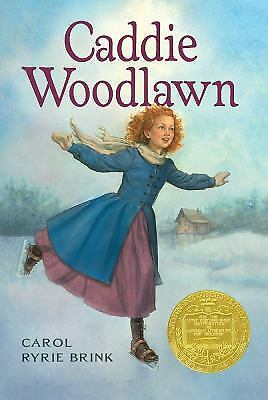
Caddie Woodlawn by Carol Ryrie Brink

Caddie Woodlawn is a sweet coming-of-age story that takes place in the 1860s. Because she was a sickly baby, her father recommends that she get plenty of exercise and sunshine playing outdoors rather than staying at home to learn domestic duties. She and brothers have wonderful adventures, but as time goes on she must decide how to balance her wildness with her femaleness. Her father helps he to see that she can be true to her adventuresome spirit while at the same time developing womanly virtues. Certainly, a book that highlights the special contribution that women make to society would not be published today, but I appreciated Brink's careful handling of this subject.

The story has some similarities to the Little House books in that Caddie's mother is disdainful of Indians while her father is more open and trusting. I couldn't help comparing the books in my mind since I re-read all the Little House books last year and was so captivated by them. Although the Woodlawn family doesn't experience the same crises as the Ingalls' clan, they face their difficulties with the same no-nonsense attitude. When Caddie falls through the ice while skating, her brothers don't run for help. Instead they find a way to save her:

With cool presence of mind, Tom made Warren lie down on the ice, and, catching hold of Warren's feet, he pushed him out over the thin ice until he could reach Caddie's groping hands. "Hold tight, Warren,"he shouted. "I'll pull you both in!" And he did. Nobody made much fuss over it. Pioneer children were always having mishaps, but they were expected to know how to use their heads in emergencies. (p. 74)

The rapscallion escapades are balanced with tender stories of Father's childhood, Caddie's growing friendship with her pesky sister, and a neighbor boy's heroism during a prairie fire. Through it all Caddie learns that though the world is filled with painful challenges, it also offers delightful surprises. She concludes that "Whatever life is like, I like it." This would be an excellent read-aloud for children.

Blessings,
 

Friday, April 5, 2019

These Happy Golden Years by Laura Ingalls Wilder

I'm not a huge fan of young love. The sighs, blushing, sweaty palms and goosebumps irritate me. I prefer the steady, time-tested love of such couples as Elizabeth and Darcy, Anne and Wentworth, and Jane and Rochester. So I was a bit dubious when vlogger Kate Howe  listed her favorite literary couples and most of them were teenagers. I watched her video, which included Almonzo and Laura, just before I started These Happy Golden Years

And I have to agree with her. Their courtship is exceptionally sweet without being saccharine. Almonzo is several years older than Laura and she has trouble seeing him as a possible suitor. When she gets a teaching job 12 miles away from home, he kindly offers to pick her up and take her back each weekend so that she can see her family. She is thrilled to have a way to escape the hardships of her job and accepts, but later decides to give up these rides because she doesn't want to give him any false hopes. She showed a lot of integrity in making that tough decision and he showed just as much in his response. To her surprise, he insists on taking her back and forth anyway saying, What do you take me for? Do you think I'm the kind of fellow that'd leave you out there at Brewster's when you're so homesick just because there's nothing in it for me?

In his gentleness and persistence, he finally wins her. All the pains he takes to make the kitchen of their new home agreeable to her may not be romantic to some people. But being married to a man whose love language is "acts of service" has taught me that they were swoon-worthy.

Another aspect of the Little House books that I've enjoyed has been the underlying faith of the Ingall's family. Wilder is never pushy about Christianity, but shows it as the natural part of their daily lives. When Pa gets out his fiddle to play, he plays a mix of Scottish ballads, American folk songs and hymns. The family attends church even when they don't particularly like the preacher. They pray, trust God, and persevere through trials. When Mary comes home from college where she has learned many skills including doing bead work and reading braille, she gives hand-made gifts to each family member. Later she tells them that having memorized Bible verses as a child had helped her in her studies: Knowing them was a great help to me, Ma. I could read them so easily with my fingers in braille that I learned how to read everything sooner than anyone else in my class. "I'm glad to know that, Mary," was all that Ma said, and her smile trembled, but she looked happier than when Mary had given her the beautiful lamp mat.

This was meant to be the end of the original 8-book series and I highly recommend it as such. The ninth book, The First Four Years, was published after Wilder's death and was a rough draft that she never completed. It is completely unlike the other books in tone and was a huge disappointment.

Blessings,

Friday, March 1, 2019

What I Read and Watched in February

I continue to stick to my New Year's resolution: NO FICTION on my Kindle until I finish 20 physical books. I miss my e-reader because that is where most of my light reading is stored. On the other hand, I am less distracted with my present reading style, so I'm pleased with that.

I finished Pilgrim's Inn and The Heart of the Family, the last two books in Elizabeth Goudge's Eliot Family trilogy. I also finished up The Little House series, wishing I had skipped the last book, The First Four Years, because it is dissonant in tone from the other books. The Long Winter and These Happy Golden Years were my favorites of the set.

I listened to The Benedict Option by Rod Dreher and although I didn't agree with everything, I greatly appreciated his deep thinking on several hard subjects. I also listened to 18 Holes with Bing, a biography by Nathaniel Crosby. I read Tozer's God's Pursuit of Man and Wiersbe's Be Wise (commentary on 1 Corinthians) on my Kindle.

I watched two old movies on YouTube, neither of which were uh-mazing. But I enjoyed the acting in the British melodrama Turn the Key Softly (1953). And I love Jean Arthur in anything, so I gladly put up with the silliness of Too Many Husbands (1940). (Though I prefer the 1963 remake with Doris Day and James Garner called Move Over Darling.)

What about you? Did you read or watch anything in February that you'd recommend?

Blessings,

Friday, February 22, 2019

The Long Winter by Laura Ingalls Wilder

I could hardly put this sixth book in the Little House series down! How on earth are the Ingalls' family going to survive The Long Winter?

The story begins with Laura offering to help Pa with the haying. Although she is very young, he relents so that he can finish before winter. Even with her small size and limited strength, she does her best and they complete the task.  I loved it that she willingly gave of herself even though it was hard. The first night she goes to bed with a feeling of accomplishment: Laura was proud. Her arms ached and her back ached and her legs ached, and that night in bed she ached all over so badly that tears swelled out of her eyes, but she did not tell anyone." (p. 9) That's almost impossible to believe in the selfish, selfie-crazed, "look at me!" world that we live in.

Everyone in the story gives of themselves even when it seems like there is nothing left to give. During that long winter they are hit by blizzard after blizzard. The food and fuel run out. The general store is bare. But complaining is forbidden. Each one is expected to do their part to keep the home running. Ma Ingalls invents recipes out of odds and ends that are left over. She creates a "button lamp" when the kerosene is gone. When there is no more coal, Mr. Ingalls comes up with a solution.

I appreciated the patience and kindness that were expressed during their trials. When Pa comes back from the store with the only food item that was left, Ma expresses her thanks, saying how thoughtful it was for him to know that they would need tea on the upcoming cold nights. With no prospect of Christmas gifts of any kind, Ma and the girls gather up their pennies and nickels to buy one item the stores are not out of - a pair of suspenders for Pa. The girls are as thrilled to give this present as their father is to receive it.

Sacrificial love is a repeated theme in all of the books and one of the reasons they merit multiple readings. A fun element in this book is that Almonzo Wilder is introduced as a part of the community. (His story is told in Book Four, Farmer Boy, but that is before he moves out west and meets the Ingalls' family.) He and his older brother Royal have several interactions with Mr. Ingalls, but not the rest of the family yet.

I was so immersed in the story of multiple blizzards that I was surprised to look up and see the sun shining through my window! And I shed a tear for joy when the "Chinook" finally blew in.

This is probably my favorite Little House book so far.

Blessings,

Friday, December 14, 2018

By the Shores of Silver Lake by Laura Ingalls Wilder

If literary figures can help to shape character, the Ingalls family is high on my list of exceptional candidates. In By the Shores of Silver Lake Wilder tells a simple tale of perseverance, faith, and sacrificial love as she recounts another slice of her childhood in the 1870s. In this fifth book in the series, readers are taken from the banks of Plum Creek out to the sprawling Dakota Territory.

If you are familiar at all with the series, this is the book in which Mary becomes blind due to scarlet fever, which makes this one of the best books I've ever read for teaching empathy. Although everyone is sorry for Mary, no one ever treats her like a victim. Nor does she act like one. She is expected to participate in family chores as much as she is able. Although blind, she is still able to sew more careful stitches than Laura. She often holds the baby and tells it stories so that Ma can do her own chores. It is assumed that other family members will help Mary when needed, especially Laura who was instructed by Pa to "see out loud" for her by describing scenes around them.

As in previous books, Laura is no Elsie Dinsmore. She likes exploring the wild prairie more than learning lessons on lady-like behavior. She struggles with the family expectation that she will grow up to be a teacher. But she (like everyone else in the family) always submits her desires to what is best for all of them. She learns a hard life lesson early in the book when her beloved pet dies and Pa goes west ahead of them. Laura knew then that she was not a little girl anymore. Now she was alone; she must take care of herself. When you must do that, then you do it and you are grown up. Laura was not very big, but she was almost thirteen years old, and no one was there to depend on. Pa and Jack had gone, and Ma needed help to take care of Mary and the little girls, and somehow to get them all safely to the west on a train. (14)

Without a hint of preachiness, Wilder succeeds in writing a story in which people are cheerfully overcoming difficulties and loving each other unselfishly. (How refreshing to read a story with none of the self-absorbed angst of modern Christian fiction!) In each book Ma and Pa express their differences of opinion about life out West, but they make compromises out of love for each other. In this novel Pa would like to keep going out West, but does not because he knows Ma wants to settle down so the girls can go to school. Ma would rather spend the winter back East, but gives into Pa's wish to stay at Silver Lake. Though Pa is the head of the house, he doesn't do anything without thinking of Caroline's wishes and needs.

In addition to their love story, there is plenty of adventure with wolves, blizzards and claim jumpers. And the simple eloquence of Wilder's prose is lovely: The Sun sank. A ball of pulsing, liquid light, it sank in clouds of crimson and silver. Cold purple shadows rose in the east, crept slowly across the prairie, then rose in heights on heights of darkness from which the stars swung low and bright. (67)

This edifying series is not just for kids!

Blessings,

Friday, October 12, 2018

On the Banks of Plum Creek by Laura Ingalls Wilder

In spite of the recent hoopla on Wilder's legacy, I still think her books should be required reading for American children. Not only are they living history books, they are rich stories of sacrifical love and perseverance in hardship.

On the Banks of the Plum Creek is 4th in the series and chronicles the family's move from Kansas to Minnesota. Upon arrival, Charles Ingalls trades his wagon and mustang horses with a man who wants to head out West. In exchange he receives a plot of land, two oxen and a dugout house. Charles has big plans to harvest wheat and build a fine house for his wife Caroline, not knowing the many discouraging challenges that will delay these dreams. From the very beginning of the book, when little Laura expresses disappointment at the loss of their horses, Pa responds with the sentiment that runs throughout the narrative: We must do the best we can, Laura, and not grumble. What must be done is best done cheerfully.

I appreciated the simple, non-preachy lessons about the Christian life. When the family is able to go to church for the first time the girls knew from Ma's voice that going to church must be better than going to a party. We find out about the cost of disobedience when we read, Laura had been bad and she knew it. She had broken her promise to Pa. But no one had seen her. No one knew that she had started to go to the swimming-hole. If she did not tell, no one would ever know. But she felt worse and worse inside. The fact that Laura repents of some sins and nourishes others shows the struggles of real human being, (as opposed to an Elsie Dinsmore-type.) There are many instances in the book where family members give up their wants for the good of another. These lessons on unselfishness are one of the main reasons parents need to keep reading these books to their children.

Sometimes the very simple language left my heart longing for more eloquence, but there were enough pretty phrases to keep me going: Grey-green lichens with ruffled edges grew flat on the rock. Wandering ants crossed it. Often a butterfly stopped to rest there. Then Laura watched the velvety wings slowly opening and closing, as if the butterfly breathed with them.

Here's A U.S.A. Today article on why we should not ban Wilder's "racist" books.

Blessings,