Thursday, February 20, 2025

The Divine Comedy by Dante

A.A. Milne famously said, "One does not argue about The Wind in the Willows.... The book is a test of character. We can't criticize it, because it is criticizing us.... When you sit down to it, don't be so ridiculous as to suppose that you are sitting in judgement on my taste, or on the art of Kenneth Grahame. You are merely sitting in judgment on yourself. You may be worthy: I don't know. But it is you who are on trial."

Truly, there are some classics I do not judge because they are so out of my realm of understanding that they need to be read humbly. The Bible, Shakespeare and Dante's Comedia all fit into that category. 

I recently re-read Inferno and Purgatorio. I was lost eighty percent of the time two years ago, but was surprised at how much more I understood and enjoyed it this second time around. It was actually the highlight of my morning three days a week. (I again used the schedule and complementary videos from the 100 Days of Dante done by Baylor University, which greatly enhanced the experience.)

While I still consider myself a neophyte in the Dantean world, I am beginning to appreciate his genius for imagery and poetical symmetry. His use of the "contrapasso" is often startling. Contrapasso is the principle that every soul must suffer in the afterlife according to the sin they committed in life. Sometimes this is shown ironically as in the punishment for fortune tellers. Because they tried to look to the future, they will spend eternity with their heads on backwards, doomed to forever looking behind rather than forward.  

Then there is something called "vertical reading," which means that in all three books (Inferno, Purgatorio and Paradiso) each canto has a similar theme. For example, Narcissus is mentioned in Canto 30 of each the three books. And it is no coincidence that all three books end with the word "star." 

Not only are there 33 cantos in each book (book one has an introductory canto which doesn't count), but there are 33 syllables per tercet (three lines of verse). There are three ladies who help, three guides, and three apostles. All this is because in Dante's world the cosmos is structured and stewarded by the three-person God. (Brian Williams talks about all of this in his brief overview of The Inferno here.)

I used a hardcopy of John Ciardi's translation, which was loaded with helpful notes, but I missed the beautiful language. Happily, I found a wonderful audioversion on Chirp, which I think might be Robert Hollander's version. 

Here's an example of the language difference:

Ciardi: Ah! What wounds I saw, some new, some old, branded upon their bodies! Even now the pain of it turns me cold.

Hollander: Ah! what wounds I marked upon their limbs, recut and old, inflicted by the flames. Even the remembrance of them grieves me yet. 

Here are a few YouTube videos that might encourage you to give Dante a try: one by Malcom Guite and one by Anthony Esolen. Karen Swallow Prior shares strong opinions about the Comedia here.

Has anyone else dipped into Dante? Do you have a favorite translation?

Blessings

Thursday, February 6, 2025

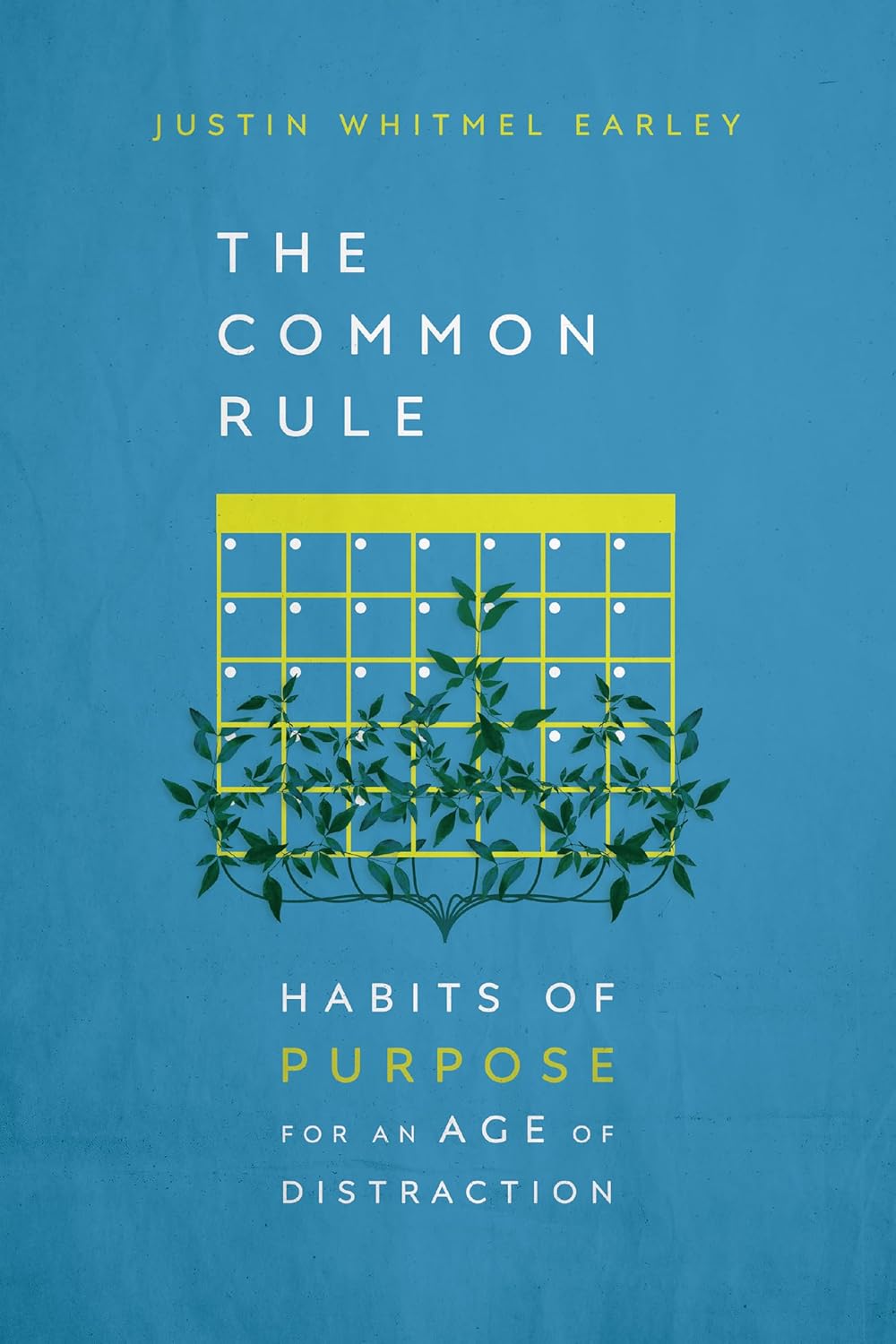
The Common Rule by Justin Whitmel Earley

There are lots of books about spiritual disciplines, but this one is unique because it addresses the use of digital media head on. When our phones take up so much of our time, how do we, as Christians, create healthy habits around them?  

Justin Whitmel Earley encourages four daily habits and four weekly habits that are designed to draw us closer to God and wean us away from dependence on social media for affirmation and dopamine hits. The daily habits are 1) Kneel for prayer three times a day, 2) Eat one meal with others, 3) Spend one hour with your cellphone off, 4) Read Scripture before turning on your phone.

The weekly habits are 1) Spend one hour of conversation with a friend, 2) Curate your media (movies/videos) to four hours, 3) Fast from something for 24 hours, and 4) Keep the Sabbath.

The chapter on Daily Habit #3 (Turn of your phone for one hour a day) was the most important chapter in the book for me, not because I don’t already limit my cell phone use, but because it gave good theological reasons for continuing to do so. Presence is the essence of life itself. It’s at the heart of who we are because presence is at the core of our relationship with God. From creation to salvation, the story of the Bible is fundamentally a story of presence. Eden was Eden because the unmediated presence of God was there. God was with Adam and Eve till sin broke the bliss of that presence. After they sinned, Adam and Eve wanted to cover their nakedness and hide. This is the hallmark of life as we know it now.  We hide from each other and we hide from God. We long for the face of God, but we can’t bear his gaze either. Sin has turned a people meant for presence into a people of absence. Fortunately, the story of the Bible doesn’t end there. God in His mercy still pursues His rebellious children.

Although I appreciated this book very much, I found parts of it to be annoying (Earley’s bragging about how good he is at speaking Chinese was one example). Also, the subtitle of this book could have been “Spiritual Disciplines for Social Justice Warriors” because of how often he tacked on social justice issues to each discipline. Don’t get me wrong. I LOVED his emphasis on spiritual disciplines that are rooted in the two commandments to “Love God and love your neighbor.” What better motivation can you have for getting off your phone than to be fully present to those around you and to pursue the goals that God has put into your heart to fulfill His purposes?

But some of the ways he prescribes to do that are just plain odd. In the chapter on curating your media time, he strongly suggests that you watch things that show the injustice in the world so that you can feel miserable about it. But feeling bad about injustice is not biblical justice. (See Voddie Baucham's explanation of the difference in this video.)

Anyway, this book stretched me in a lot of ways and I'm glad I read it. Any thoughts?

Blessings, 

Thursday, January 23, 2025

The Wayne Family Trilogy by Elizabeth Cadell

Elizabeth Cadell (1903-1989) was a British writer of light, clean love stories. Usually I'm not a fan of straight romance novels, but occasionally I'll read one to take a break from heavier fare. This series was unexpectedly delightful.

In the first book, The Lark Shall Sing, Lucille Wayne has decided to sell the family home, and her decision brings her five siblings from near and far to protest the action. The mayhem that ensues is hilarious. Cadell does a wonderful job of describing each sibling, and I couldn't help loving Julia, bibliophile and "ugly duckling" of the family. There is a fairytale quality to the story with characters who appear "out of the blue" to help make the satisfying resolution possible; I enjoyed both Pietro and Miss Cornhill as much as the regular members of the Wayne family. The inevitable romance was not front and center.

The second book, The Blue Sky of Spring, takes place a year later and its tone is not as jovial. In fact, instead of the family antics of the first book, this one includes a mystery regarding a spinster who dies suddenly after trying to change her will. A romance is predominant, but not annoyingly so. It was a pleasure to spend more time with each member of the family, watching them grow through the stresses and strains of their shared lives. 

The third and final book, Six Impossible Things, happens ten years later, which allows you to see young Julia all grown up. She has just returned from Italy where she has been studying piano under the famous "Albano". Nicholas, her older brother, fails to see how she has bloomed from an awkward youngster into a charming young woman. A large part of the story is their growing understanding of each other. Yes, there is the requisite romance, but quite a lot of other subplots as well. I loved the emphasis on community and the ties that bind people together. 

The only downside to the series was the occasional light swearing, but that did not keep me from enjoying the many afternoons I spent with the wild and wonderful Waynes. (I read these books through my Kindle Unlimited subscription, which I got for three months for 99 cents!)

Blessings,

Thursday, January 9, 2025

Love as a Choice - quote by Jan Karon

Father Tim reflects on the long journey it has been to earn the love and trust of a "discarded" boy.

I had to love [Dooley] when he threw his shoe at the wall and  cussed my dog, love him when he called me names I won’t repeat, love him when he refused to eat what I’d cooked after celebrating and preaching at three Sunday services…. You get the idea. I enjoyed the warm feelings, the stuff of the heart, when it was present between us, as it sometimes was, even in the beginning. But when it wasn’t, there was the will to love him, something like a generator kicking in, a backup.

Excerpt from In the Company of Others, p. 261

I love that simile. When the "power's out" (our own human strength), God gives us the resources to keep on giving and loving.

(Photo by Gabriella Clare Marino at Unsplash)

Blessings,

Monday, December 30, 2024

Reading Year in Review 2024

It's always fun to look over the year and pick out my favorite books. The most challenging books still "haunt" me many months later - probably because they demanded so much of my heart and mind when I was reading them. Here's the list:

Favorite Light Reads: The last eight books in Jan Karon's Mitford series (four of which were new to me) and three Agatha Christie mysteries: Sad Cypress, Five Little Pigs, The Secret of Chimneys

Most Challenging: Till We Have Faces (The Lit Life Podcast episodes from 2020 added helpful commentary.)

Favorite Audio: The Iliad (lectures by Elizabeth Vandiver) 

Favorite Non-fiction: When Morning Gilds the Skies (reviewed here)

Favorite Vintage: Set in Silver (reviewed here)

Most Delightful Discovery: The poetry of William Wordsworth

Classic that I Tackled (for the second time): Dante's Inferno. I have physical copies of  Ciardi's translation, but longed for something more beautifully written. Happily, I found Hollander's delightful audioversion on Chirp for 99 cents! Reading along with the 100 Days of Dante group was one of the highlights of my year.

The Book That I Loved In Spite of Myself: The Power and the Glory by Graham Greene. Such a dark story, but so beautifully written. Many important religious themes.

Favorite of the Year: The Christmas Pig by J.K. Rowling. Brilliant storytelling (reviewed here)

This link  to Goodreads shows all 95 books that I read in 2024.

It was a very good year for building my literary muscles! What about you? Did you read something good that caught you by surprise?

Blessings,

Friday, December 27, 2024

What I Read and Watched in December 2024

I normally have a low tolerance for Hallmark movies (except for the mysteries), but I watch a couple at Christmastime to relax and enjoy the snowy scenes. Imagine my surprise at loving A Biltmore Christmas! It a time-travel story, and, yes, it is extremely silly, but it pays homage to several delightful vintage Christmas flicks. This spoof of classic Hollywood had me chuckling all the way through. I also watched Elf, The Nativity Story (reviewed here), a Christmas western (!) called Three Godfathers, and a 1937 tear-jerker, Make Way for Tomorrow) because it came highly recommended by Anthony Esoloen). Lastly, I watched Since You Went Away, a classic movie (nominated for nine academy awards) which details the homefront sacrifices of one American family during WWII. Claudette Colbert is always fun to watch and the cinematography is phenomenal. 

It's summertime here in Brazil, so I can't actually curl up with a book
next to the fire, but I did the next best thing by reading the following Christmas titles: The Anne of Green Gables Christmas Collection, Winter Fire (advent readings based on G.K. Chesterton's writings), and The Christmas Mouse by Miss Read. Two comforting audiobooks were The Hobbit and Miss Buncle's Book by D.E. Stevenson. 

It was a very good month! Did you read any good Christmas titles?

Blessings,

Friday, December 20, 2024

When Morning Gilds the Skies by Dr. John Oswalt

I have a masters in theology, but this book taught me more about the Old Testament than I ever knew. Did you know that there is no Hebrew word for "presence" so that when the Bible talks about God's presence, the literal translation is "His face"? 

Dr. Oswalt has written commentaries on the books of Isaiah and Exodus so I was not suprised that he had so much to teach me, but this is no dry textbook. Every page is saturated with reminders that God invites us to walk in intimate fellowship with Him. This book could easily be called a primer on sanctification because every question you've ever had about it is answered clearly and winsomely. 

Here's an excerpt from October 27: Do we need the Old Testament? Many people today, including some prominent preachers, say no, but they are wrong. We do need the Old Testament. Why? The answer is pretty simple; we need the Old Testament to understand the New Testament correctly. The two testaments complement each other. Each one is incomplete without the other. For instance, it is very easy to make the God of the New Testament just a kindly grandfather who will let you get away with anything. On the other hand, it is very easy to make the Old Testament God a terrifying ogre who will strike you dead if you cross Him. Neither view is correct.... We need both testaments to get an adequate picture of God. For example, the Cross is the answer, but what is the question? Why did Jesus die? If you only know the New Testament, you may well say that it is, "How can our sins be forgiven so we can go to heaven?" But that is wrong. The question the Cross is answering is the Old Testament one: "How can a holy God take up residence in a sinful person?" Does God want to forgive our sins? of course. But that is the begining of the story of redemption, not the end. (p. 318) 

Dr. John Oswalt makes the Scriptures come alive with his insightful commentary. A really wonderful devotional book!

Blessings,