Showing posts with label Christian classics. Show all posts

Thursday, August 7, 2025

Orthodoxy by G.K. Chesterton

G.K. Chesterton is one of the great thinkers of the 20th century, but sometimes his brilliance can be blinding, and I struggle to grasp his meanings. That certainly hasn’t kept me from trying (as my book log of 17 of his titles shows!)

Chesterton is best remembered for responding to the famous skeptics of his day (George Bernard Shaw, Oscar Wilde, and Frederick Nietzsche, to name a few) with his hard-hitting yet witty counter-arguments against their staunch atheism. Orthodoxy, his best-known rebuttal, outlines his reasons for embracing Christian truths. His principal reason was that Christianity is the only religion that gives a sane explanation for this world. But he is quick to say that it is more than a conglomeration of right opinions: I will not call it my philosophy; for I did not make it. God and humanity made it; and it made me.

One quote from the book has stayed with me for many weeks. What we suffer from today is humility in the wrong place. Modesty had moved from the organ of ambition and has settled upon the organ of conviction, where it was never meant to be. A man was meant to be doubtful about himself, but undoubting about the truth; this has been exactly reversed. Nowadays the part of a man that a man does assert is exactly the part that he ought not to assert – himself. The part he doubts is exactly the part he ought not to doubt – the Divine Reason. This seems to define so much of the thinking I see in our culture (i.e. the triumph of self-delusion over clear biblical precepts).

Chesterton’s sense of wonder and “joie de vivre” keep his writings from being too didactic. I especially loved Chapter 4 on how fairy tales shaped his heart to believe in God. I had always believed that the world involved magic; now I thought that perhaps it involved a magician. Later he remarks, I left the fairy tales on the nursery floor and have not found any books so sensible since. (!)

His closing chapter was on the healthful confines of Christianity. Within its supposedly constricting limits, there is unrestricted joy. He writes, Catholic doctrine and discipline may be walls, but they are the walls of a playground. He writes beautifully of the freedom and exhilaration of knowing one’s Creator and of knowing one’s purpose as His creatures (as opposed to the despair of nihilism.)

I’ll leave you with one final quote by G.K. on the Trinity: It is indeed a fathomless mystery of theology. Suffice it to say that this triple enigma is as comforting as wine and as open as an English fireside; this thing that bewilders the intellect utterly quiets the heart.

This was my bedtime book for many months. I read two to three pages per night because that was all my brain could handle. But I think Chesterton is better read in small, well-chewed bites. It doesn’t do to read him in a hurry. 
Blessings,

Thursday, February 20, 2025

The Divine Comedy by Dante

A.A. Milne famously said, "One does not argue about The Wind in the Willows.... The book is a test of character. We can't criticize it, because it is criticizing us.... When you sit down to it, don't be so ridiculous as to suppose that you are sitting in judgement on my taste, or on the art of Kenneth Grahame. You are merely sitting in judgment on yourself. You may be worthy: I don't know. But it is you who are on trial."

Truly, there are some classics I do not judge because they are so out of my realm of understanding that they need to be read humbly. The Bible, Shakespeare and Dante's Comedia all fit into that category. 

I recently re-read Inferno and Purgatorio. I was lost eighty percent of the time two years ago, but was surprised at how much more I understood and enjoyed it this second time around. It was actually the highlight of my morning three days a week. (I again used the schedule and complementary videos from the 100 Days of Dante done by Baylor University, which greatly enhanced the experience.)

While I still consider myself a neophyte in the Dantean world, I am beginning to appreciate his genius for imagery and poetical symmetry. His use of the "contrapasso" is often startling. Contrapasso is the principle that every soul must suffer in the afterlife according to the sin they committed in life. Sometimes this is shown ironically as in the punishment for fortune tellers. Because they tried to look to the future, they will spend eternity with their heads on backwards, doomed to forever looking behind rather than forward.  

Then there is something called "vertical reading," which means that in all three books (Inferno, Purgatorio and Paradiso) each canto has a similar theme. For example, Narcissus is mentioned in Canto 30 of each the three books. And it is no coincidence that all three books end with the word "star." 

Not only are there 33 cantos in each book (book one has an introductory canto which doesn't count), but there are 33 syllables per tercet (three lines of verse). There are three ladies who help, three guides, and three apostles. All this is because in Dante's world the cosmos is structured and stewarded by the three-person God. (Brian Williams talks about all of this in his brief overview of The Inferno here.)

I used a hardcopy of John Ciardi's translation, which was loaded with helpful notes, but I missed the beautiful language. Happily, I found a wonderful audioversion on Chirp, which I think might be Robert Hollander's version. 

Here's an example of the language difference:

Ciardi: Ah! What wounds I saw, some new, some old, branded upon their bodies! Even now the pain of it turns me cold.

Hollander: Ah! what wounds I marked upon their limbs, recut and old, inflicted by the flames. Even the remembrance of them grieves me yet

Here are a few YouTube videos that might encourage you to give Dante a try: one by Malcom Guite and one by Anthony Esolen. Karen Swallow Prior shares strong opinions about the Comedia here.

Has anyone else dipped into Dante? Do you have a favorite translation?

Blessings

Friday, November 8, 2024

Best-read vs. Well-Read - Quote from Dennis Kinlaw

Five years ago I posted a quote from one of my favorite pastors and thinkers, Dr. Dennis Kinlaw, on the importance of deep reading. This week I was listening to one of his sermons, and was delighted to hear more of his literary journey. He shares about a time as a young pastor when he was acting as chauffeur for visiting speaker, A. W. Tozer:

Tozer had an 11th grade education. I had my Masters of Divinity degree and had studied a couple of years at Princeton. We talked books, and he told me about books I never knew existed. He was the best-read man I had ever talked with. Maybe not the most widely read, but the best-read. As we talked about books, he suddenly looked at me and said, "Kinlaw, don't ever read a good book!" I blinked and said, "I beg your pardon?" He said, "You'll never have time to read all the best ones, for goodness sake don't waste your time on a good one." 

That was a moment of liberation for me because I had a lot of friends. When we pastors would meet together, one of them would say, "Have you read...?" and I wanted to be able to say, "Oh, yes, I've read.... But have you read...?" And we played one-upmanship with each other. And the prize went to the one who'd read the most, not the one who'd read the best. 

After that moment, I found myself re-reading some things. You know you don't get any credit for a second and third time through. But it will make a radical change in the inner dialogue of your inner being. So I've always given thanks to A.W. Tozer [for deepening my reading life.]

I don't think this means that we only have to read theology books. But I do know that once I trained my literary taste buds to enjoy deeper books, it became very hard to read fluff. In between Christian classics, I also enjoy WWII memoirs, children's lit and vintage detective fiction. Plus, now that I'm 63, I definitely don't have to time to read mediocre books!

Blessings,

Thursday, October 24, 2024

The Four Loves by C.S Lewis

I was intrigued when I heard that C.S. Lewis narrated this book himself, and was pleased to see that my library had it for digital download. But I didn’t realize that there were two versions. The one that Lewis does so wonderfully is a set of four lectures he gave on the radio in 1958, and is basically a rough draft of the final book, which was released two years later. I enjoyed the radio talks so much that I dug out my physical copy to underline favorite bits. I discovered, however, that it was practically impossible to find the same passages because the final book is twice as long as the radio talks. Obviously, he reworked and rewrote quite a bit of it.

The four loves are 1) Storgé/familial love, 2) Friendship, 3) Eros/romantic love, and 4) Agape/Charity. His description of storgé was so endearing that I had to stop listening and write it down. It comes from Greek and refers to affection, especially of parents to children.

It’s usually the humblest of the loves. It gives itself no airs. Storge is modest, even furtive and shame-faced. Storge has a very homely face. So have many of those for whom we feel it. It’s no proof of your cleverness or perceptiveness or refinement that you love them nor that they love you. To have to produce storge in public is like getting your household furniture out for a move. It was all right in its native place, but it looks tawdry out of doors. And the feeling of storge is so nearly organic, so gradual, so unemphatic, that you can no more pride yourself on it than on getting sleepy towards bedtime. It lives with humble, unpraised private things: the thump of a drowsy dog’s tail on the kitchen floor, the sound of a sewing machine, easy laughter and easy tears on some shrewd and wrinkled old face, a toy left on the lawn. It’s the most comfortable and least ecstatic of loves. It is to our emotions what soft slippers and an easy, almost worn-out chair, and old clothes are to our bodies. It wraps you round like a blanket almost like sleep. At its best, it gives you the pleasure, ease, and relaxation of solitude without solitude itself.

Beautiful, right? But just when I was completely enamored, he delineates all the ways this kind of love can be distorted. That is how the book goes. He explains each type of love at its glorious best and then shows how easily it can turn into something manipulative and selfish. His conclusion comes in the final chapter where he emphasizes the importance of self-giving love as the only solution for keeping the other loves from becoming corrupted. In this chapter he writes his famous lines:

To love at all is to be vulnerable. Love anything, and your heart will certainly be wrung and possibly be broken. If you want to make sure of keeping it intact, you must give your heart to no one, not even to an animal. Wrap it carefully round with hobbies and little luxuries; avoid all entanglements; lock it up safe in the casket or coffin of your selfishness. But in that casket – safe, dark, motionless, airless – it will change. It will not be broken; it will become unbreakable, impenetrable, irredeemable…. The only place outside Heaven where you can be perfectly safe from the dangers and perturbations of love is Hell. (p. 121)

Note: The book gets a bad rap for some comments he makes about the differences between men and women, but, honestly, don’t let that keep you from reading it. Anything written by Lewis is worth tackling for his wonderful clarity and depth.  


Blessings,

Friday, August 16, 2024

Abide in Christ by Andrew Murray

Oswald Chambers (through his classic devotional My Utmost for His Highest) has often been the "kick in the pants" I've needed to keep me from being a lazy Christian. But when I feel fragile and need encouragement from a more sympathetic counselor, Andrew Murray is the one to whom I turn. His call to the holy life is just as strong as Chamber's, but his approach is decidedly more gentle and winsome. 

Teacher and theologian Dr. John Oswalt, in his book When Morning Gilds the Skies, writes, Many Christians are trying to live God's life in their own ability and wondering why they so often fail. It is when we allow the Spirit of God to take us over, to fill us, that He enables you and me to live His life. Yes, we have to cooperate with Him. Yes, we have to do our part, but in the end, it's a life of rest, of settling down in Him and allowing Him to do what we cannot do.

That is the continuous message that you hear in Murray's 31-day devotional Abide In Christ. My heart was encouraged and strengthened and I marked many passages to re-read.

Day 28 seems to have been written just for me: The Christian often tries to forget his weakness; God wants us to remember it and feel it deeply. The Christian wants to conquer his weakness and to be freed from it; God wants us to rest and even rejoice in it. The Christian mourns over his weakness; Christ teaches us to say, 'I take pleasure in infirmities; most gladly will I rejoice in them.' The Christian thinks his weakness his greatest hindrance in service to God; God tells us that is the secret of strength and success. It is our weakness heartily accepted, and continually realized, that gives us our claim and access to His strength. (II Cor 12:9)

A lovely bedside book!

Blessings,

Thursday, March 14, 2024

The Betrothed by Alessandro Manzoni

I often say I prefer Catholic authors to modern Christian fiction writers because they address human suffering without giving overly simplistic answers. The Betrothed by Alessandro Manzoni is a perfect example.

The novel take place in Italy in the 17th century, and covers actual historical events of that time, particularly the plague of 1630. Renzo and Lucia are pledged to be married to one another, but serious impediments arise that keep them apart for several years. Can their love withstand the challenges that each must face alone?

Fortunately, this is much more than a story of separated lovers. There are villains and heroes. In the midst of political instability, lawlessness, famine, kidnapping, rioting, and narrow escapes, themes emerge of redemption, forgiveness, and trust in God's ultimate plan. It shows suffering as the great equalizer. When famine comes, both the rich and poor go hungry. When the plague hits, both outlaws and saints succumb to death. AND yet there is a difference in the reactions to the calamities. Some become hardened and rob the dead bodies and pillage the houses. Others lay their lives on the line to help the helpless. Though written from a Catholic perspective, The Betrothed does not blindly glorify Catholicism. Selfish, ungodly leaders intermingle with the humble and self-giving ones. 

During the plague, the priests are given the task of manning the lazarettos (housing for the sick and dying). Manzoni writes that as the plague took its toll, means, men and courage failed as the necessity for the lazarettos increased. Nine out of ten of the priests died. But where suffering was, there they were

Without giving any big spoilers, I will say that both Lucia and Renzo grow through their trials and learn that God never disturbs the joys of His children but to prepare them for one more certain and endurable. Manzoni reminds us that the most cautious and blameless conduct cannot secure us from troubles. [But] when they come, whether by our own fault or not, confidence in God alleviates them and makes them cohesive to a better life.

If anything, the book teaches that the Christian life is full of testing, but that God is faithful.

The Betrothed is supposedly the most famous and widely read novel in the Italian language. I listened to a good translation, but I will admit that it was still not easy to get through. Some of the chapters on politics and geography (and even the detailed descriptions of the plague) were laborious. The audiobook, narrated by Nicholas Bolton, helped me to stick with it, and when it was all done, I felt deeply nourished by the hours I had spent in this book. 

Anyone else familiar with this title?

Blessings,

Thursday, June 22, 2023

Introduction to the Devout Life by St. Francis de Sales

Introduction to the Devout Life
has been on my TBR list for at least 20 years so when I heard that the Catholic Classics podcast was going to cover it, I jumped on board. What better way to understand a Catholic classic than through the eyes of two priests? I ended up getting "two-for-the-price-of-one" because they not only commented on each chapter, they read the chapter at the beginning of each episode.

The book is based on actual letters written to Madame Louise de Charmoisy, the wife of one of St. Francis' cousins, who had asked him for spiritual guidance. He was later encouraged to compile his advice into a volume aimed at a more general audience. In the book, he addresses his letters to "Philothea" (lover of God) and it is written in a wonderful, fatherly tone.

Therefore, my daughter, I say that although it is lawful to amuse yourself, to dance, to dress, to feast, and see seemly plays, - at the same time, if you are much addicted to these things, they will hinder your devotion, and become extremely hurtful and dangerous to you. The harm lies, not in doing them, but in the degree to which you care for them. It is a pity to sow the seed of vain and foolish tastes in the soil of your heart, taking up the place of better things, and hindering the soul from cultivating good dispositions.

One of the great strengths of the book is its powerful imagery. After he advises Philothea to read and ponder over Scripture each day, he writes, At the end of your meditation linger a while, and gather, so to say, a little spiritual bouquet from the thoughts you dwelt upon, the sweet perfume whereof may refresh you through the day.

Sometimes the chapters were meaty enough to require no additional comments. At other times the chapters were "just okay," but the commentary that followed was stellar. On Day 16, for example, the subject was on the necessity of humility and Father Gregory remarked, We can enter this life of humility because we realize it is not ours to create, but ours to enter into. There's a beauty to that. There's a difficulty, but also a beauty and a confidence that we ought to have as Christians that God is at work. He loves you. He wants to share His life with you. And that's what the devout life is all about. Full stop. That's what we are chasing after. Like Holiness, it's His gift to give and ours to receive.  

Even though I underlined something on almost every page, I'm not sure why I am not more enthusiastic about Introduction to the Devout Life. The Catholic emphases were off putting at times, which may be why I don't recommend it wholeheartedly. It could be because my top book in 2022 was William Law's A Serious Call to a Devout and Holy Life, which I think is more accessible. 

While I couldn't always keep up with the podcasts, I managed to read one short chapter from the book each day and was enriched by each one. I'm very glad I finally tackled this devotional classic.

Blessings,

Thursday, January 26, 2023

What I Read and Watched in January 2023

I read a variety of books this month: The Grand Sophy by Georgette Heyer (sophisticated fluff), Beauty in the Word by Stratford Caldecott (on what makes for true education), Rebecca by Daphne du Maurier (suspenseful audiobook that I ended up disliking intensely, reviewed here), and Diary of Private Prayer by John Baillie. 

I enjoyed several classic movies. It Happened One Night (1934) is a wonderful screwball comedy (with a little too much drinking) starring Clark Gable and Claudette Colbert. It is one of only three movies to win the five major Oscars (Best Picture, Best Actor, Best Actress, Best Director, Best Writing). The Whole Town's Talking (1935) had Edward G. Robinson, usually a tough-talking gangster, playing a mousy roll in a case of mistaken identities. It co-stars Jean Arthur who is always delightful. The Human Comedy (1943) was one of the hundreds of films produced during WWII to encourage those on the home front. Sappy by modern standards, it has good acting and storytelling; it was fascinating to see many major actors in minor roles except for Mickey Rooney who was at the height of his career as America's favorite adolescent. (Donna Reed would shoot to stardom three years later in It's a Wonderful Life.) This link leads to the library scene, "The Wonder of Books," which is a favorite. In the Good Old Summertime (1949) is a musical version of Shop Around the Corner. (All the songs were vehicles for Judy Garland and had very little to do with the story.) By the title you'd never know it was a Christmas movie. A must-see for all fans of You've Got Mail. I watched all of these on YouTube except for It Happened One Night, which I have on DVD.

Read anything good in January? Any other classic movie fans out there? 

Blessings,

Friday, October 28, 2022

The Valley of Vision by Arthur Bennett

The Valley of Vision is a powerful antidote to the popular teaching that Christianity is primarily about personal success and happiness. My husband and I have been reading a prayer a day for the past year and have often been overwhelmed with the beauty and clarity of each one. 

The focus is always on Christ rather than self. An example from the prayer on repose: Thou art so good, wise, just, holy, that no mistake is possible to thee... I yield to thy sovereignty all that I am and have; do thou with me as thou wilt. Thou has given me silence in my heart in place of murmurings and complaints. Keep my wishes from growing into willings, my willings from becoming fault-finding with thy providences, and have mercy on me.

I loved the book so much that I hate to mention my one quibble with it: the occasional emphasis on self-loathing. A humble recognition of our unworthiness to receive God's grace is everywhere in Scripture. Self-hatred is not. Many verses remind us that God has blotted out our transgressions to remember them no more. Who are we to undo what God has done?

That was a minor complaint. Overall, The Valley of Vision is a rich resource for godly, heartfelt prayers that point us to our heavenly Father in trust and worship. A final quote that I loved was, Give me knowledge of thy goodness that I might not be over-awed by thy greatness; give me Jesus, Son of Man, Son of God, that I might not be terrified, but be drawn near with filial love and holy boldness

The Gospel Coalition has an interesting post on the origin of these prayers, which were written by Arthur Bennett (1915-1994). Because Bennett uses the beautiful language of the original prayers (adapting them very slightly), it is hard to believe that this classic was first published in 1975. 

Blessings

Thursday, September 22, 2022

A Serious Call to a Devout and Holy Life by William Law

After 30 years of teaching Theology of John Wesley, I finally decided to read A Serious Call because apart from the Bible it was one of the books that most formed Wesley’s thinking about Christianity. Law begins this devotional classic by defining the nature and extent of Christian devotion, which holds little resemblance to what passes for Christianity today. He reminds us that it is a “serious call” after all, and requires every ounce of our being.

The first chapter goes straight to the sticky issue of how Christians should spend their money.  Using our money in any way we please, says Law, shows we lack intention to please God in all our actions. (Wesley followed Law’s advice to the letter by living frugally all of his life and giving money away as fast as possible. He felt that accumulating wealth was equivalent to holding on to hot coals.)

The next chapters encourage a wholehearted pursuit of God by rising early, reading the Scriptures and singing the Psalms. He writes: Prayer is the nearest approach to God, and the highest enjoyment of Him that we are capable of in this life. It is the noblest exercise of the soul, the most exalted use of our best faculties and the highest imitation of the blessed inhabitants of heaven.

Starting with Chapter 16 he adds suggestions for how to take advantage of certain hours of the day for specific prayers. At 9 a.m., for example, a Christian should spend a few minutes focusing on his need for humility. (He follows with a whole chapter on what true humility entails.) In Chapter 20 he recommends using the noon hour to pray for more love toward others, and follows this up with a clear explanation of  the high cost of real love. (This was my favorite chapter in the whole book and I felt it could easily have been re-titled: "How to pray for those whom you despise and learn to love them in the process.")

Chapter 22 advocates stopping at 3 p.m. to pray prayers of consecration and resignation to God’s will. The whole nature of virtue consists in conforming to, and the whole nature of vice in declining from, the will of God…. Whenever you find yourself disposed to uneasiness or murmuring at anything that is the effect of God’s providence over you, you must look upon yourself as denying either the wisdom or goodness of God. For every complaint necessarily supposes ill usage. (Ouch!)

In Chapter 23 he suggests stopping at 6 p.m. to review the day and confess any sins that were committed. Oddly, the updated version of this book removes all mentions of specific times of day (to avoid sounding too Catholic?) and thus robs the reader of a simple method for remembering when and how to pray for these needs. Tripp’s version was also jarringly anachronistic. The language was not updated very much, but the examples were, which resulted in old-fashioned English phrases next to illustrations about people playing video games, wearing yoga pants and watching movies. Halfway through the Tripp version, I switched to the original version and had no problem with the language or the original examples. And the Dover version came with very helpful footnotes.

Once I got hold of a good version (free download from my library), I couldn’t believe how much I loved this book. It is a book to be read slowly and prayerfully that will comfort and strengthen the heart of any earnest seeker.

Blessings,

Thursday, September 30, 2021

What I Read and Watched in September

I read a nice variety of books this month. I'm enjoying the 100 days of Dante challenge more than I thought I would. It is not easy reading, but the short teaching videos put out by Baylor have been outstanding. Two audiobooks that I enjoyed were Dr. Jekyll and Mr. Hyde, and Pied Piper by Nevil Shute (reviewed here)

The rest of my fiction was pretty light. Least favorite was One Tuesday Morning by Karen Kingsbury (reviewed here). I also read a WWII mystery called Proceed at Will (reviewed here), A Man Called Trent by Louis L'amour (reviewed here), Sarah's Cottage by D. E. Stevenson, and The Proper Place by O. Douglas. (I bought it for $1.99 for Kindle, but can only find the link to the overpriced hard copy.) 

Two non-fiction titles were Matthew Henry's commentary on Song of Solomon (review here) and an abridged Journal of John Wesley (reviewed here

My favorite book of the month was All Creatures Great and Small by James Herriot, reviewed here.

I found several Hallmark mysteries on YouTube. Sweet Revenge is the latest in the Hannah Swenson "Murder, She Baked" mysteries and is definitely the funniest of them all. Mystery 101: Deadly History and two Aurora Teagarden mysteries rounded up the list. 

Blessings,

Friday, September 17, 2021

How to Get Started Reading Dante

When I heard about the 100 Days of Dante challenge, I knew it would give me the motivation to approach his daunting classic, The Divine Comedy. I read three books beforehand to provide background, but without having read the actual text, they were not as helpful as I had hoped. I still felt lost as I began reading The Inferno (book one of three). Since I pride myself in having developed literary muscle through the years, I was dismayed that it was still a struggle to understand what was happening. 

At first I listened to the short lectures given by Dante scholars from Baylor before reading each canto, but realized that I had no idea what they were talking about. I floundered a bit before deciding to read the assigned (short) canto before AND after listening to the teaching video. That meant that I had to spend 20 to 30 minutes on each canto (just three times a a week if you are following the 100 Days with Dante schedule). Searching and comparing translations, and finding one that worked for me, also made a huge difference. Listening while reading was also helpful. (There are many free audio versions on YouTube.)

I will not say that I am still understanding everything perfectly, but I'm glad for all the resources available that act as training wheels for the uninitiated like me. The passion that the Baylor profs have for Dante is contagious. 

Regarding translations... Because I live in Brazil, I could only do comparisons using Kindle samples. That eliminated some respected translations such as Dorothy Sayers' and Anthony Esolen's because no Kindle samples were available. The most readable classic translation was by poet John Ciardi, but I thought it odd that he did not include the best line from Canto 1 (line 39 about God's Divine Love being the creative force of the universe). He left out that idea all together even though it is clearly there in the Italian. (I only know that because it is similar to Portuguese!)

The digital versions I liked the most (clear without dumbed-down language) were by Clive James, Robert Durling, and Gerald J. DavisHenry Wadsworth Longfellow has a version that's free, which isn't too difficult if you are used to King James' English. Ironically, I ended up using Ciardi because I found an inexpensive set of his Comedia in English here in Brazil. His introductory commentary and footnotes have been extremely helpful.

Anyone else read Dante? Are you reading along with the 100 Days challenge? Any more tips?

Blessings,

Friday, March 12, 2021

The Ministry of Intercession by Andrew Murray

We all know we should pray more, but why are we so reluctant? Andrew Murray deals with this question head on in his book The Ministry of Intercession. And he does not waste any time mollycoddling his readers. We may complain of lack of time or lack of motivation, but Murray writes,

Feebleness and failure in prayer is a sign of feebleness in the spiritual life. If we lack in this area, we lack in many others. Prayer is meant to be as simple and natural as breathing to a healthy person. The reluctance we feel, and the failure to confess, are God’s own voice calling us to acknowledge our disease, and to come to Him for the healing He has promised…. To pray aright, the life of the Spirit must be right in us. For praying the effectual, much-availing prayer of the righteous man, everything depends on being full of the Spirit…. Beware of grieving him by sin, by unbelief, by selfishness, by unfaithfulness to His voice in your conscience. You can count on him to do in your heart all that ought to be done there.

That last sentence is crucial. Instead of loading us with guilt for not praying enough, Murray emphasizes over and over that when Christ calls us to do something, He also enables it. Rest assured that if Christ is calling you to prayer, he will heal your reluctance and your lethargy. You can trust Him to restore your spiritual strength. Pray with humility and yet with confidence that He will teach you.

I appreciated Murray’s thorough explanations of several key Bible passages on prayer, especially the one in Luke 11 that appears to teach that if we nag God long enough, He has to give in to us. I also appreciated his emphasis on the privilege of prayer: Christ has taken believers up into partnership with himself; He has honored them, and bound Himself, by making their prayers one of the standard measures of the working of His power.

The appendix of the book is a thirty-day plan for taking baby steps toward a deeper prayer life. I highly recommend this book if you want to grow in the area of intercession. I have one caveat though. If you are not familiar with Murray’s other books, which emphasize complete surrender to God and to His will, you could misconstrue several statements in this book that seem to reflect the “name it, claim it” mentality of the prosperity gospel.

This title was free at the time of posting. If you have never read Murray, I would suggest these other (more accessible) titles first. The True Vine (99 cents) and Humility (free) are two of my favorites.

Blessings,

Thursday, February 18, 2021

Kristin Lavransdatter by Sigred Undset

I rarely review a book unless I love it, but Kristin Lavransdatter is an exception. Undset’s three-volume story of a 14th Century woman’s life in Norway was hard to get through, yet worth the effort.  Although I am not a Catholic, I have a deep appreciation for Catholic authors who write about sin, suffering and redemption without fluffy conclusions.

Kristin Lavransdatter (“daughter of Lavran”) grew up in a devout family but chose to go against her parents’ principles in her choice of husband. It is hard to review the book without spoilers so I will just say the bad choices made in the first book ("The Bridal Wreath") have a ripple effect throughout the rest of the trilogy. It is a devastating critique of the high cost of sin. Yet it miraculously avoids being preachy.

References to immoral behavior are discreet, but frequent and troubling. Undset did such a remarkable job of creating living, breathing characters that I agonized over each one of them. So much so that I finally did something I rarely do. To reduce the anxiety, I read a synopsis of the books so that I could be better prepared emotionally for what was coming up next. For that reason, I did not “ugly cry” at the end of the book, which is what most people say they do. Admittedly, I was in a daze, but that is as far as it went.

I would never have finished the book if it had not been for the members of the Literary Life podcast group who cheered me on. (I was even part of a Lavransdatter Support Group on Facebook!) Although I had the audiobook, I soon learned that it was more painful to hear the story, than to read it, so I used the audio format sparingly.

Why recommend this difficult title? Because it powerfully portrays men and women in all their glory and in all their brokenness trying to make sense of the world through their mixed lenses of superstition and Catholicism. It describes the joys and suffering of motherhood in a way I've rarely seen in fiction. And there are tiny threads of grace woven throughout the narrative that keep it from being completely hopeless.  

Now I can check this title off of my "14th Century book" category. I think I'll take a breather, however, before I pick up "book I've most avoided" (Anna Karenina.) The Literary Life reading challenge for 2021 is posted here

Blessings,

Thursday, May 28, 2020

What I Read and Watched in May

We started the month with a re-watch of Hidden Figures, which was just as good the second time around. In general I have very little patience for Hallmark movies, but I enjoy their mysteries when I get a chance. So I was happy to find Roux the Day and Three Bedrooms, One Corpse, which were good, clean (yet forgettable) fun. BUT Fixer-Upper Mystery: Concrete Evidence was the most suspenseful HM movie I've ever watched. I thoroughly enjoyed it.

I was delighted to see that hard-to-find author, O. Douglas, (who wrote Penny Plain, a vintage favorite) had more titles available for Kindle and immediately bought six of them. I re-read Penny Plain before tackling its sequel, Priorsford. Sadly, Priorsford did not meet my expectations.

My other reads for the month were theological: The Power of the Blood of Jesus by Andrew Murray (reviewed here) and Grace, Faith and Holiness, a theology textbook that I've been reading for months. (review here)

My absolute favorite of the month was L.M. Montgomery's  Emily of New Moon, which I'll be reviewing soon.

I discovered several free books this month: 365 Meditations from George McDonald's Fiction, Serious Call to a Devout and Holy Life by William Law (Christian classic, 1729), and The Last Man by Mary Shelley (possibly the first post-apocalyptic novel, 1826) I can't vouch for any of these titles, but thought if you are reading this blog, you might have similar tastes in books.

Blessings,

Friday, May 15, 2020

The Power of the Blood of Jesus by Andrew Murray

Of my top ten Christian classics, three titles are by Andrew Murray so I was prepared to enjoy The Power of the Blood of Jesus. Still, it was more theologically dense than some of his other books. 

One of Murray’s most helpful insights was on the holiness of God. We often think only of its negative aspect, i.e., that He hates sin. But Murray points out that the positive side of His holiness is that He is good, loves goodness and wants to make us good (holy). Holiness, as we wrongfully understand it, is the priggish keeping of rules. But to Murray Holiness is a disposition in entire agreement with that of God, which chooses in all things to will as God wills. It is nothing more than oneness with God, effected by intimacy with Him.   

Chapter 8 had a helpful explanation of Christ’s words in John 6:53 (“Drink my blood”). It’s hard enough to wrap our modern sensibilities around the idea of being “washed in the blood,” but the admonition to drink it is mind-boggling. Murray simplifies the idea by using water as an example. Water cleanses outwardly, but to be life-giving, it must be imbibed. Without drinking the blood of the Son of God – i.e., without hearty appropriation of it – eternal life cannot be obtained. Not only must the blood do something for us by placing us in a new relationship with God (forgiveness), but it must also do something in us (cleansing), entirely renewing us within.

He who “drinks” the blood of Jesus, receives Christ’s eternal, abundant life into himself. Only as we allow Him to fill us with Himself can we live the Christian life. This is the resounding theme of all of Murray’s books - the fruitfulness of a life completely surrendered to Christ.

If you are new to Murray, I would suggest either Humility (free for Kindle) or The True Vine to introduce you to these important ideas. But if you are ready for something a little meatier, The Power of the Blood of Jesus (free at the moment) will certainly stretch your thinking.  


Blessings,

Friday, May 1, 2020

What I Read and Watched in April

Though I'm still in a stress-induced brain fog, I managed to read several classics this month. I tried to listen to an audio version of Bambi, but disliked it so much that I gave it up halfway through (review here). My Antonia by Willa Cather, on the other hand, was an excellent audio book. Another book that was surprisingly good was The Best-Loved Poems of Jacqueline Kennedy-Onassis. I read a few poems a day and found consolation in their beauty. Persuasion by Jane Austen was a perfect comfort read.

My Christian non-fiction for the month was Affliction by Edith Schaeffer, which was a solid, sensible look at suffering. (reviewed here) There's never any fluff with Edith Schaeffer.

My biggest disappointment was Rose Daughter by Robin McKinley (reviewed here) because I loved her book, Beauty, so much.

As far as movies go, I watched Across the Pacific with Humphrey Bogart and Mary Astor because I had heard the banter was witty. It was filmed in 1942 and Japanese stereotypes are rampant, but the repartee between the protagonists was perfect. I also watched the 1971 BBC version of Persuasion after reading the book. The hairstyles and dress were dated, but I thought the actress who played Anne was lovely. She was beautiful but had lost the bloom of youth (just as Anne is described in the novel).


We watched the first season of VidAngel's series on the life of Christ called The Chosen. My husband and I are such biblical purists that we thought we'd hate it. But it was actually very well done and we enjoyed it. I liked the series, but I LOVED the pilot, The Shepherd, which is available on YouTube.

Did you have a favorite book or movie this month?

Blessings,

Friday, February 28, 2020

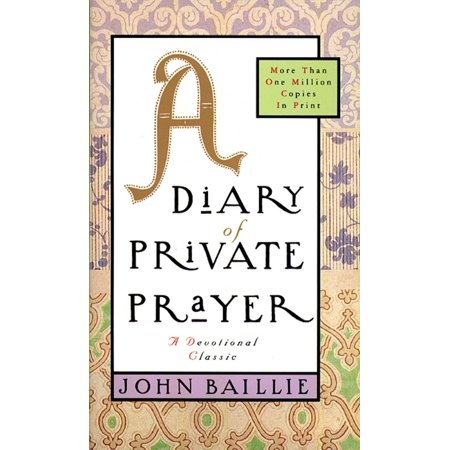
A Diary of Private Prayer by John Baillie

I do not come from a tradition of written prayers, so I was surprised at how much I enjoyed this devotional classic. A Diary of Private Prayer, written by Scottish theologian John Baillie (1886-1960), contains a month of heartfelt prayers, one for each morning and evening. Frankly, the humble, submissive attitude of these prayers was a welcome change from much of modern Christian literature.

An example from Day Four: Do not let me embark on anything today that is not in line with your will for my life, nor shirk from any sacrifice that your will demands.

Mingled with the prayers of surrender to God's will are praises for His goodness and power. On Day Twenty-Two, he writes, O Lord, my God, I kneel before you in humble adoration as I set out to face the tasks and interests of another day. Thank you for the blessed assurance that I shall not be called upon to face them alone or in my own strength, but that at all times I will be accompanied by your presence and strengthened by your grace.

One final favorite prayer: O Holy Spirit, visit my soul and stay within me all day. Inspire all my thoughts. Pervade all my imagination. Suggest all my decisions. Make your home in the most secret place of my will and inspire all my actions. Be with me in my silence and in my speech, in my hurry and in my leisure, in company and in solitude, in the freshness of the morning and in the weariness of the evening; and give me grace at all times to rejoice in the comforting mystery of your companionship.

My only quibble is the occasional general prayer for "all the workers in the world," or "all who suffer." I have a hard time understanding how God is supposed to answer such non-specific petitions, but I may be underestimating His far-reaching grace.

It's hard to imagine that anyone could read this book every day and not be changed by it. My edition, with updated language by Susanna Wright, was very readable. The hard cover and ribbon bookmark guarantee its use for many years to come.

Blessings,

Friday, October 4, 2019

Thoughts on Prayer by Oswald Chambers

Prayer develops and nourishes the life of God in us. We generally look upon prayer as a means of getting things for ourselves, but the biblical idea of prayer is that God’s holiness, purpose, and wise order may be brought about. 

“Your Father knows the thing you have need of before you ask Him”(Matt 6:8). Then why ask? Very evidently our ideas about prayer and Jesus Christ’s are not the same. Prayer to Him is not a way to get things from God, but so that we may get to know God. Prayer is not to be used as the privilege of a spoiled child seeking ideal conditions to indulge his spiritual propensities. The purpose of prayer is to reveal the presence of God, equally present at all times and in every condition.

During a war many pray for the first time. It is not cowardly to pray when we are at our wits’ end. It is the only way to get in touch with reality. As long as we are self-sufficient and complacent, we don’t need to ask God for anything. We don’t want Him. It is only when we know we are powerless that we are prepared to listen to Jesus and to do what He says.

It is not so true that “prayer changes things” as that prayer changes us.

(All above quotes are from If You Will Ask: Reflections on Prayer by Oswald Chambers)

Blessings,

Friday, September 13, 2019

Miracles by C. S. Lewis

I understood so little of  the first chapters of Miracles that I was tempted to give up. But when I saw that Chapter 14 was on the Grand Miracle (the incarnation), I knew I had to hang on. Everyone knows the famous quote, We believe the sun is in the sky at midday in summer not because we can clearly see the sun, but because we can see everything else. But its context is the incarnation. To Lewis, God's act of becoming man is the light that clarifies all other Christian doctrines.

In the first half of the book Lewis argues for the naturalness of miracles. Contrary to popular opinion, they do not go against natural laws, but confirm them. If the laws of Nature are necessary truths, no miracle can break them: but no miracle need break them. It is with them as with the laws of arithmetic. If I put six pennies in a drawer on Monday and six more on Tuesday, the laws decree that - other things being equal - I shall find twelve pennies on Wednesday. But if the drawer has been robbed, I may in fact only find two. Something will have been broken (the lock of the drawer or the laws of England) but the laws of arithmetic will not have been broken.... 

We are in the habit of talking as if the laws of Nature caused events to happen; but they never caused any event at all. The laws of motion do not set billiard balls moving: they analyze the motion after something else has provided it. They produce no events; they state the pattern to which every event must conform. Thus in one sense the laws of Nature cover the whole field of space and time; in another, what they leave out is precisely the whole, real universe - the incessant torrent of actual events which make up true history.... A miracle is emphatically not an event without cause or without results, Its cause is the activity of God; its results follow according to Natural law.

On the necessity of the incarnation: In the Christian story God descends to re-ascend. He comes down; down from the heights of absolute being into time and space, down into humanity; down further still, if embryologists are right, to recapitulate in the womb ancient and pre-human phases of life; down to the very roots and sea-bed of the Nature He has created. But He goes down to come up again and bring the whole ruined world up with Him.

On Christ's death: On the one hand Death is the triumph of Satan, the punishment of the Fall, and the last enemy. On the other hand, only he who loses his life will save it. We are baptized into the death of Christ, and it is the remedy for the Fall. Death is, in fact, ambivalent. It is Satan's greatest weapon and also God's great weapon; it is holy and unholy, our supreme disgrace and our only hope, the thing Christ came to conquer and the means by which He conquered.

Lewis also addresses the important topics of prayer, free will vs. God's sovereignty (always a mind bender), death/rebirth and the spiritual vs. the material. I loved his quirky phrase for the idea that all reality is found in Christ: He is ultimate Fact-hood. This was a difficult but extremely worthwhile book for building mental and spiritual muscle.

Blessings,